



BECKER oil-free vacuum pumpsfor industry
41 BECKER dry-vane vacuum pumps for industry across Africa, Asia and the Middle East: VT, VX, KVT, KVX, VTLF, VXLF and VARIAIR, with technical selection support, maintenance guidance and spare parts.
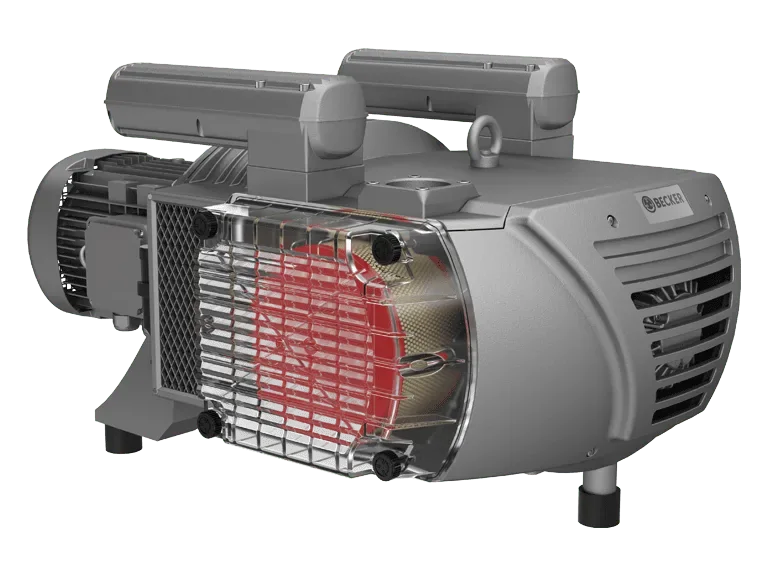
BECKER vacuum pumps for Africa, Asia and the Middle East
Exportvacio supports industrial customers looking for BECKER oil-free vacuum pumps, compressors, technical selection and original spare parts across Africa, Asia and the Middle East. This English catalog brings together the BECKER dry-vane range, operating data, industrial applications, maintenance guidance and model-selection information in one technical resource.
Africa
Technical support for industrial vacuum applications, replacement pumps and original BECKER spare parts for customers and projects across African markets.
Asia
BECKER dry-vane vacuum technology for manufacturing, packaging, printing, woodworking, electronics and other industrial processes across Asian markets.
Middle East
Industrial vacuum solutions for production, maintenance and engineering teams across Gulf and wider Middle Eastern markets, with model-selection and quotation support.
Regional search coverage includes key industrial markets such as the United Arab Emirates, Saudi Arabia, Qatar, Oman, Bahrain, Kuwait, South Africa, Egypt, Morocco, Kenya, Nigeria, India, Singapore, Malaysia, Thailand, Indonesia and other markets across Africa, Asia and the Middle East. Availability, electrical configuration, lead time and logistics are confirmed for each quotation.
Advantages of BECKER dry-vane vacuum pumps in industrial production
The advantage of a dry pump goes beyond simply eliminating process oil. In an industrial installation, service continuity, maintenance effort, mechanical integration, vane life and the ability to match flow to actual demand all matter. This section separates the benefits common to BECKER dry-vane technology from those that apply specifically to the X Series.X and a the configurations VARIAIR.
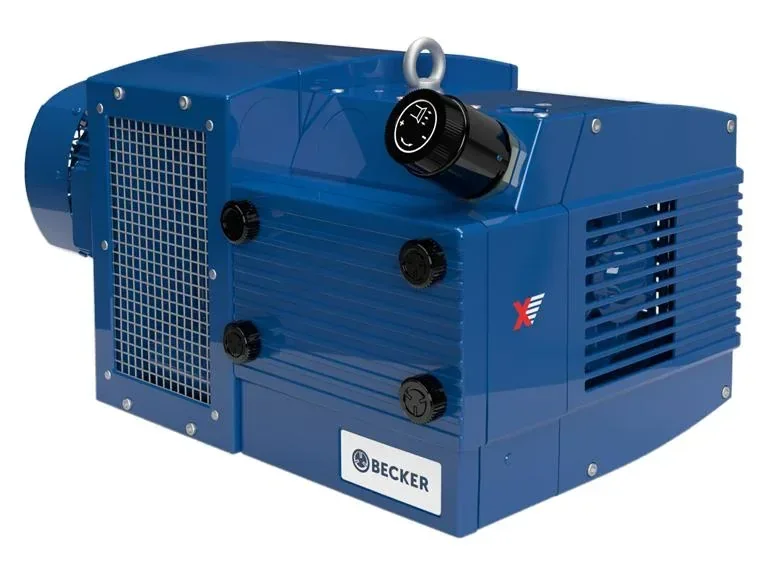
A robust architecture designed for dry industrial vacuum
BECKER describes these pumps as positive-displacement machines with self-lubricating graphite-composite vanes. The dry series are designed for continuous duty within their specified operating range and do not require oil changes in the compression chamber.
No oil changes in the compression chamber
Dry operation eliminates process-oil replacement and avoids using oil as part of the chamber sealing mechanism. This simplifies maintenance and is valuable when an oil-free vacuum circuit is required.
The benefit is greatest with clean, dry air. If the process draws moisture, condensate, particles or vapours, suitable filtration and separation must be correctly sized.
Simpler, more predictable maintenance
BECKER describes its dry series as low-maintenance pumps. Service is focused mainly on filtration, cleaning, cooling, vane-condition inspection and checking the installation for leaks.
Low maintenance does not mean maintenance-free: a clogged filter, inadequate ventilation or vanes outside tolerance can reduce flow and increase operating temperature.
Designed for continuous duty
VT, VX, KVT, KVX, VTLF, VXLF and their corresponding configurations are positive-displacement pumps designed for continuous industrial duty within the permissible vacuum range of each series.
The pump must operate within its performance curve and absolute-pressure limit, with ambient temperature, ventilation and backpressure compatible with the technical data.
Compact machine integration
Direct drive, air cooling and compact construction simplify installation close to the machine or within a centralized vacuum system without additional mechanical transmission components.
Allow sufficient space for airflow, filter removal, vane replacement, electrical access and pump removal when service is required.
X Series: high performance and long service life
BECKER X Series families prioritize a high-performance architecture with graphite-composite vanes designed for extended service life. For VX, KVX and VXLF, BECKER publishes a vane design life of up to 20,000 hours, always dependent on the duty point, installation and actual operating conditions.
This is a specific X Series advantageX, not a universal promise for every dry pump. Actual service life depends on the application, contamination, temperature, operating vacuum and maintenance.
VARIAIR: flow matched to demand
VARIAIR versions incorporate frequency control, allowing speed to be adjusted when the process does not always require the same flow. In the published dry-vane series, control typically operates between 30 and 60 Hz.
Variable-speed control does not by itself guarantee energy savings. The benefit depends on demand profile, idle periods, leakage, setpoint and machine-control strategy.
What is common to the dry range and what is specific to X or VARIAIR
This distinction avoids comparing a standard VT with a VX or VARIAIR version using benefits that do not apply to the same configuration.
| Feature | VT · KVT · VTLF | VX · KVX · VXLF | VARIAIR |
|---|---|---|---|
| Operation dry oil-free | Yes | Yes | Yes |
| Self-lubricating graphite vanes | Yes | Yes | Yes |
| Continuous duty | Yes, depending on range | Yes, depending on range | Yes, depending on range |
| vanes engineered for up to 20,000 operating hours | — | Yes | Only when based on X Series technology X |
| Variable-speed control by frequency converter | — | — | Yes |
| No compression-chamber oil change required | Yes | Yes | Yes |
Dry operation is not the best choice for every process: the technology must match the application
BECKER also manufactures oil-lubricated pumps and other technologies. Dry-vane pumps are appropriate when the gas is suitable for dry operation, oil is undesirable in the compression chamber and the required vacuum lies within the selected series operating range.
BECKER dry-vane pumps
- Oil-free in the compression chamber
- No process-oil changes
- Suitable for clean, dry air
- Maintenance focused on filters, vanes and cooling
When another technology may be a better fit
- A deeper vacuum than the dry-series operating range
- High moisture or condensable load
- Process containing incompatible liquids or contamination
- Operating point outside the selected family performance curve
The actual advantage appears when the pump operates at the correct duty point
To compare two BECKER models, send the required flow, absolute operating vacuum, duty cycle, gas type, leakage, voltage/frequency and ambient conditions. This allows selection between a standard series, X Series or VARIAIR configuration.
41 BECKER dry-vane models
Compare 41 BECKER models by flow, absolute vacuum, frequency, power and application. Exportvacio supplies BECKER pumps and spare parts for customers across Africa, Asia and the Middle East.
Try another reference, change the family or show all 41 models again.
Compare up to 3 BECKER pumps
Select catalog models to compare their published technical data in a single table.
Select 2 or 3 models to start the comparison.
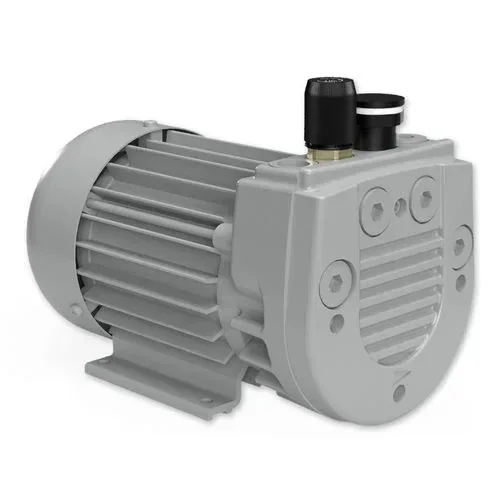
BECKER VT 4.2
Dry rotary-vane vacuum pump for continuous industrial duty, with self-lubricating vanes and integrated vacuum regulation.
Complete technical data
| Flow rate 50 Hz | 1.9 m³/h |
|---|---|
| Absolute vacuum 50 Hz | 400 mbar |
| Power 50 Hz | 0.09 kW |
| Sound level 50 Hz | 56.0 dB(A) |
| Flow rate 60 Hz | 2.3 m³/h |
| Absolute vacuum 60 Hz | 400 mbar |
| Power 60 Hz | 0.11 kW |
| Sound level 60 Hz | 58.0 dB(A) |
| Weight published | 7.0 kg with motor |
Dimensions and connection
Dimensions and connections may vary with motor, voltage, orientation, accessories and configuration. Always confirm against the drawing for the exact order number before fabricating a base frame or piping.
Technology
- 100% dry operation, oil-free compression chamber
- Self-lubricating graphite-composite vanes
- Air cooling
- Designed for continuous duty
Standard equipment
- Large integrated inlet filter
- Combined vacuum regulating and safety valve
- Acoustically optimized exhaust valve
BECKER VT 4.4
Dry rotary-vane vacuum pump for continuous industrial duty, with self-lubricating vanes and integrated vacuum regulation.
Complete technical data
| Flow rate 50 Hz | 4.1 m³/h |
|---|---|
| Absolute vacuum 50 Hz | 150 mbar |
| Power 50 Hz | 0.18 kW |
| Sound level 50 Hz | 59.0 dB(A) |
| Flow rate 60 Hz | 4.7 m³/h |
| Absolute vacuum 60 Hz | 150 mbar |
| Power 60 Hz | 0.21 kW |
| Sound level 60 Hz | 61.0 dB(A) |
| Weight published | 7.0 kg with motor |
Dimensions and connection
Dimensions and connections may vary with motor, voltage, orientation, accessories and configuration. Always confirm against the drawing for the exact order number before fabricating a base frame or piping.
Technology
- 100% dry operation, oil-free compression chamber
- Self-lubricating graphite-composite vanes
- Air cooling
- Designed for continuous duty
Standard equipment
- Large integrated inlet filter
- Combined vacuum regulating and safety valve
- Acoustically optimized exhaust valve
BECKER VT 4.8
Dry rotary-vane vacuum pump for continuous industrial duty, with self-lubricating vanes and integrated vacuum regulation.
Complete technical data
| Flow rate 50 Hz | 8.0 m³/h |
|---|---|
| Absolute vacuum 50 Hz | 150 mbar |
| Power 50 Hz | 0.37 kW |
| Sound level 50 Hz | 58.0 dB(A) |
| Flow rate 60 Hz | 9.1 m³/h |
| Absolute vacuum 60 Hz | 150 mbar |
| Power 60 Hz | 0.44 kW |
| Sound level 60 Hz | 61.0 dB(A) |
| Weight published | 11.5 kg with motor |
Dimensions and connection
Dimensions and connections may vary with motor, voltage, orientation, accessories and configuration. Always confirm against the drawing for the exact order number before fabricating a base frame or piping.
Technology
- 100% dry operation, oil-free compression chamber
- Self-lubricating graphite-composite vanes
- Air cooling
- Designed for continuous duty
Standard equipment
- Large integrated inlet filter
- Combined vacuum regulating and safety valve
- Acoustically optimized exhaust valve
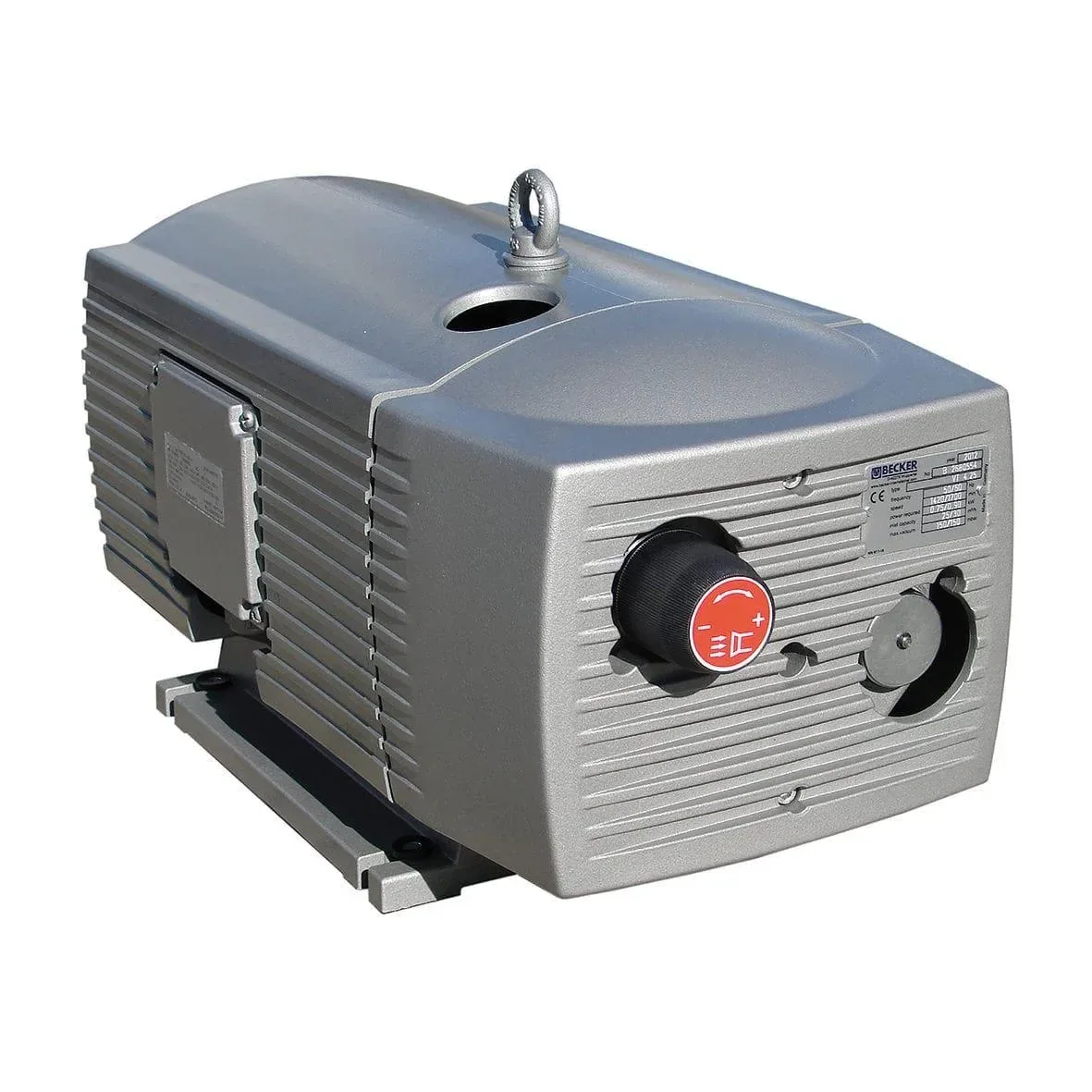
BECKER VT 4.10
Dry rotary-vane vacuum pump for continuous industrial duty, with self-lubricating vanes and integrated vacuum regulation.
Complete technical data
| Flow rate 50 Hz | 10 m³/h |
|---|---|
| Absolute vacuum 50 Hz | 150 mbar |
| Power 50 Hz | 0.37 kW |
| Sound level 50 Hz | 60.0 dB(A) |
| Flow rate 60 Hz | 12 m³/h |
| Absolute vacuum 60 Hz | 150 mbar |
| Power 60 Hz | 0.45 kW |
| Sound level 60 Hz | 62.0 dB(A) |
| Weight published | 16.0 kg with motor |
Dimensions and connection
Dimensions and connections may vary with motor, voltage, orientation, accessories and configuration. Always confirm against the drawing for the exact order number before fabricating a base frame or piping.
Technology
- 100% dry operation, oil-free compression chamber
- Self-lubricating graphite-composite vanes
- Air cooling
- Designed for continuous duty
Standard equipment
- Large integrated inlet filter
- Combined vacuum regulating and safety valve
- Acoustically optimized exhaust valve
BECKER VT 4.16
Dry rotary-vane vacuum pump for continuous industrial duty, with self-lubricating vanes and integrated vacuum regulation.
Complete technical data
| Flow rate 50 Hz | 16 m³/h |
|---|---|
| Absolute vacuum 50 Hz | 150 mbar |
| Power 50 Hz | 0.55 kW |
| Sound level 50 Hz | 61.0 dB(A) |
| Flow rate 60 Hz | 19 m³/h |
| Absolute vacuum 60 Hz | 150 mbar |
| Power 60 Hz | 0.70 kW |
| Sound level 60 Hz | 64.0 dB(A) |
| Weight published | 22.5 kg with motor |
Dimensions and connection
Dimensions and connections may vary with motor, voltage, orientation, accessories and configuration. Always confirm against the drawing for the exact order number before fabricating a base frame or piping.
Technology
- 100% dry operation, oil-free compression chamber
- Self-lubricating graphite-composite vanes
- Air cooling
- Designed for continuous duty
Standard equipment
- Large integrated inlet filter
- Combined vacuum regulating and safety valve
- Acoustically optimized exhaust valve
BECKER VT 4.25
Dry rotary-vane vacuum pump for continuous industrial duty, with self-lubricating vanes and integrated vacuum regulation.
Complete technical data
| Flow rate 50 Hz | 25 m³/h |
|---|---|
| Absolute vacuum 50 Hz | 150 mbar |
| Power 50 Hz | 0.75 kW |
| Sound level 50 Hz | 62.0 dB(A) |
| Flow rate 60 Hz | 30 m³/h |
| Absolute vacuum 60 Hz | 150 mbar |
| Power 60 Hz | 0.90 kW |
| Sound level 60 Hz | 67.0 dB(A) |
| Weight published | 26.0 kg with motor |
Dimensions and connection
Dimensions and connections may vary with motor, voltage, orientation, accessories and configuration. Always confirm against the drawing for the exact order number before fabricating a base frame or piping.
Technology
- 100% dry operation, oil-free compression chamber
- Self-lubricating graphite-composite vanes
- Air cooling
- Designed for continuous duty
Standard equipment
- Large integrated inlet filter
- Combined vacuum regulating and safety valve
- Acoustically optimized exhaust valve
BECKER VT 4.40
Dry rotary-vane vacuum pump for continuous industrial duty, with self-lubricating vanes and integrated vacuum regulation.
Complete technical data
| Flow rate 50 Hz | 40 m³/h |
|---|---|
| Absolute vacuum 50 Hz | 150 mbar |
| Power 50 Hz | 1.25 kW |
| Sound level 50 Hz | 67.0 dB(A) |
| Flow rate 60 Hz | 48 m³/h |
| Absolute vacuum 60 Hz | 150 mbar |
| Power 60 Hz | 1.50 kW |
| Sound level 60 Hz | 72.0 dB(A) |
| Weight published | 38.5 kg with motor |
Dimensions and connection
Dimensions and connections may vary with motor, voltage, orientation, accessories and configuration. Always confirm against the drawing for the exact order number before fabricating a base frame or piping.
Technology
- 100% dry operation, oil-free compression chamber
- Self-lubricating graphite-composite vanes
- Air cooling
- Designed for continuous duty
Standard equipment
- Large integrated inlet filter
- Combined vacuum regulating and safety valve
- Acoustically optimized exhaust valve
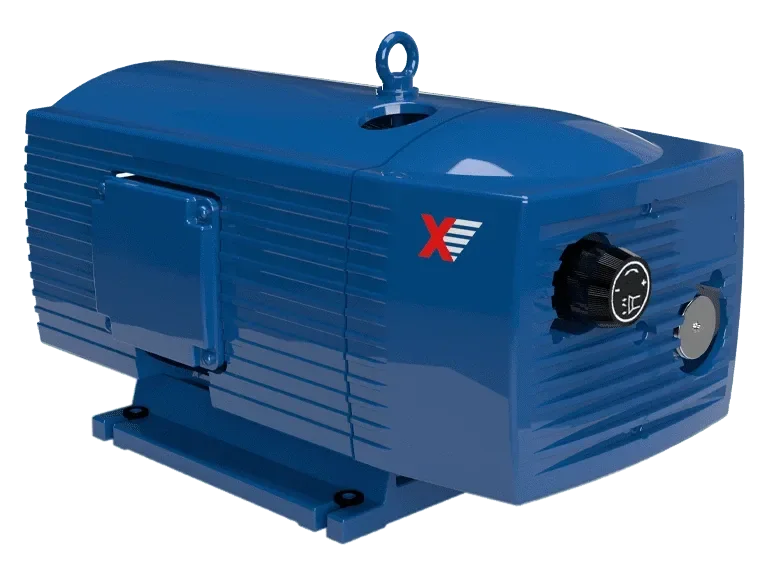
BECKER VX 4.10
Dry X Series pump Xfor continuous duty. Its graphite-composite vanes are designed for an extended service life of up to 20,000 hours.
Complete technical data
| Flow rate 50 Hz | 10 m³/h |
|---|---|
| Absolute vacuum 50 Hz | 100 mbar |
| Power 50 Hz | 0.37 kW |
| Sound level 50 Hz | 60.0 dB(A) |
| Flow rate 60 Hz | 12 m³/h |
| Absolute vacuum 60 Hz | 100 mbar |
| Power 60 Hz | 0.45 kW |
| Sound level 60 Hz | 62.0 dB(A) |
| Weight published | 16.0 kg with motor |
Dimensions and connection
The public web data does not show dimensions/connections for this configuration. Request the dimensional drawing for the exact order number before defining the base frame or piping.
Technology
- 100% dry operation, oil-free compression chamber
- Self-lubricating graphite-composite vanes
- Series X: vanes designed for an extended service life of up to 20,000 h
- Air cooling
- Designed for continuous duty
Standard equipment
- Large integrated inlet filter
- vacuum regulating valve
- Exhaust silencers
- Vibration isolators
BECKER VX 4.16
Dry X Series pump Xfor continuous duty. Its graphite-composite vanes are designed for an extended service life of up to 20,000 hours.
Complete technical data
| Flow rate 50 Hz | 16 m³/h |
|---|---|
| Absolute vacuum 50 Hz | 100 mbar |
| Power 50 Hz | 0.55 kW |
| Sound level 50 Hz | 61.0 dB(A) |
| Flow rate 60 Hz | 19 m³/h |
| Absolute vacuum 60 Hz | 100 mbar |
| Power 60 Hz | 0.70 kW |
| Sound level 60 Hz | 64.0 dB(A) |
| Weight published | 22.5 kg with motor |
Dimensions and connection
The public web data does not show dimensions/connections for this configuration. Request the dimensional drawing for the exact order number before defining the base frame or piping.
Technology
- 100% dry operation, oil-free compression chamber
- Self-lubricating graphite-composite vanes
- Series X: vanes designed for an extended service life of up to 20,000 h
- Air cooling
- Designed for continuous duty
Standard equipment
- Large integrated inlet filter
- vacuum regulating valve
- Exhaust silencers
- Vibration isolators
BECKER VX 4.25
Dry X Series pump Xfor continuous duty. Its graphite-composite vanes are designed for an extended service life of up to 20,000 hours.
Complete technical data
| Flow rate 50 Hz | 25 m³/h |
|---|---|
| Absolute vacuum 50 Hz | 100 mbar |
| Power 50 Hz | 0.75 kW |
| Sound level 50 Hz | 62.0 dB(A) |
| Flow rate 60 Hz | 30 m³/h |
| Absolute vacuum 60 Hz | 100 mbar |
| Power 60 Hz | 0.90 kW |
| Sound level 60 Hz | 67.0 dB(A) |
| Weight published | 26.0 kg with motor |
Dimensions and connection
The public web data does not show dimensions/connections for this configuration. Request the dimensional drawing for the exact order number before defining the base frame or piping.
Technology
- 100% dry operation, oil-free compression chamber
- Self-lubricating graphite-composite vanes
- Series X: vanes designed for an extended service life of up to 20,000 h
- Air cooling
- Designed for continuous duty
Standard equipment
- Large integrated inlet filter
- vacuum regulating valve
- Exhaust silencers
- Vibration isolators
BECKER VX 4.40
Dry X Series pump Xfor continuous duty. Its graphite-composite vanes are designed for an extended service life of up to 20,000 hours.
Complete technical data
| Flow rate 50 Hz | 40 m³/h |
|---|---|
| Absolute vacuum 50 Hz | 100 mbar |
| Power 50 Hz | 1.25 kW |
| Sound level 50 Hz | 67.0 dB(A) |
| Flow rate 60 Hz | 48 m³/h |
| Absolute vacuum 60 Hz | 100 mbar |
| Power 60 Hz | 1.50 kW |
| Sound level 60 Hz | 72.0 dB(A) |
| Weight published | 38.5 kg with motor |
Dimensions and connection
The public web data does not show dimensions/connections for this configuration. Request the dimensional drawing for the exact order number before defining the base frame or piping.
Technology
- 100% dry operation, oil-free compression chamber
- Self-lubricating graphite-composite vanes
- Series X: vanes designed for an extended service life of up to 20,000 h
- Air cooling
- Designed for continuous duty
Standard equipment
- Large integrated inlet filter
- vacuum regulating valve
- Exhaust silencers
- Vibration isolators
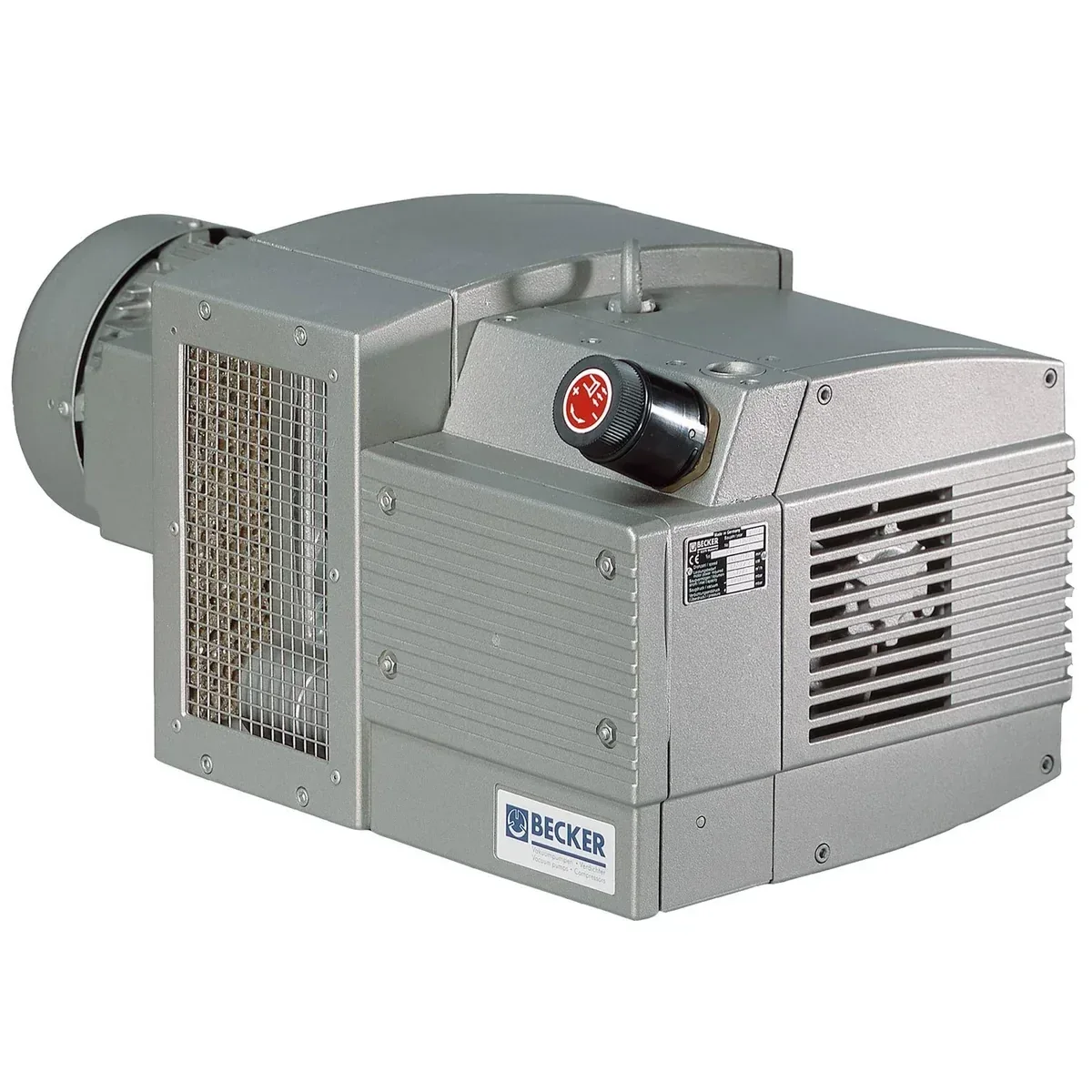
BECKER KVT 3.60
medium-capacity dry-vane vacuum pump for continuous duty, air-cooled and equipped with self-lubricating graphite-composite vanes.
Complete technical data
| Flow rate 50 Hz | 55 m³/h |
|---|---|
| Absolute vacuum 50 Hz | 100 mbar |
| Power 50 Hz | 2.2 kW |
| Sound level 50 Hz | 71.0 dB(A) |
| Flow rate 60 Hz | 66 m³/h |
| Absolute vacuum 60 Hz | 100 mbar |
| Power 60 Hz | 2.6 kW |
| Sound level 60 Hz | 73.0 dB(A) |
| Weight published | 47 kg without motor |
Dimensions and connection
Dimensions and connections may vary with motor, voltage, orientation, accessories and configuration. Always confirm against the drawing for the exact order number before fabricating a base frame or piping.
Technology
- 100% dry operation, oil-free compression chamber
- Self-lubricating graphite-composite vanes
- Air cooling
- Designed for continuous duty
Standard equipment
- Large integrated inlet filter
- vacuum regulating valve
- Exhaust silencers
- Vibration isolators
BECKER KVT 3.80
medium-capacity dry-vane vacuum pump for continuous duty, air-cooled and equipped with self-lubricating graphite-composite vanes.
Complete technical data
| Flow rate 50 Hz | 67 m³/h |
|---|---|
| Absolute vacuum 50 Hz | 100 mbar |
| Power 50 Hz | 2.2 kW |
| Sound level 50 Hz | 72.0 dB(A) |
| Flow rate 60 Hz | 78.5 m³/h |
| Absolute vacuum 60 Hz | 100 mbar |
| Power 60 Hz | 2.6 kW |
| Sound level 60 Hz | 75.0 dB(A) |
| Weight published | 49 kg without motor |
Dimensions and connection
Dimensions and connections may vary with motor, voltage, orientation, accessories and configuration. Always confirm against the drawing for the exact order number before fabricating a base frame or piping.
Technology
- 100% dry operation, oil-free compression chamber
- Self-lubricating graphite-composite vanes
- Air cooling
- Designed for continuous duty
Standard equipment
- Large integrated inlet filter
- vacuum regulating valve
- Exhaust silencers
- Vibration isolators
BECKER KVT 3.100
medium-capacity dry-vane vacuum pump for continuous duty, air-cooled and equipped with self-lubricating graphite-composite vanes.
Complete technical data
| Flow rate 50 Hz | 98 m³/h |
|---|---|
| Absolute vacuum 50 Hz | 100 mbar |
| Power 50 Hz | 3.0 kW |
| Sound level 50 Hz | 75.0 dB(A) |
| Flow rate 60 Hz | 112 m³/h |
| Absolute vacuum 60 Hz | 100 mbar |
| Power 60 Hz | 3.6 kW |
| Sound level 60 Hz | 77.0 dB(A) |
| Weight published | 71 kg without motor |
Dimensions and connection
Dimensions and connections may vary with motor, voltage, orientation, accessories and configuration. Always confirm against the drawing for the exact order number before fabricating a base frame or piping.
Technology
- 100% dry operation, oil-free compression chamber
- Self-lubricating graphite-composite vanes
- Air cooling
- Designed for continuous duty
Standard equipment
- Large integrated inlet filter
- vacuum regulating valve
- Exhaust silencers
- Vibration isolators
BECKER KVT 3.140
medium-capacity dry-vane vacuum pump for continuous duty, air-cooled and equipped with self-lubricating graphite-composite vanes.
Complete technical data
| Flow rate 50 Hz | 129 m³/h |
|---|---|
| Absolute vacuum 50 Hz | 100 mbar |
| Power 50 Hz | 4.0 kW |
| Sound level 50 Hz | 76.0 dB(A) |
| Flow rate 60 Hz | 154 m³/h |
| Absolute vacuum 60 Hz | 200 mbar |
| Power 60 Hz | 4.8 kW |
| Sound level 60 Hz | 79.0 dB(A) |
| Weight published | 78 kg without motor |
Dimensions and connection
Dimensions and connections may vary with motor, voltage, orientation, accessories and configuration. Always confirm against the drawing for the exact order number before fabricating a base frame or piping.
Technology
- 100% dry operation, oil-free compression chamber
- Self-lubricating graphite-composite vanes
- Air cooling
- Designed for continuous duty
Standard equipment
- Large integrated inlet filter
- vacuum regulating valve
- Exhaust silencers
- Vibration isolators
BECKER KVX 3.60
Medium-capacity X Series vacuum pump Xfor continuous duty, with graphite-composite vanes designed for an extended service life of up to 20,000 hours.
Complete technical data
| Flow rate 50 Hz | 55 m³/h |
|---|---|
| Absolute vacuum 50 Hz | 100 mbar |
| Power 50 Hz | 2.2 kW |
| Sound level 50 Hz | 71.0 dB(A) |
| Flow rate 60 Hz | 66 m³/h |
| Absolute vacuum 60 Hz | 100 mbar |
| Power 60 Hz | 2.6 kW |
| Sound level 60 Hz | 73.0 dB(A) |
| Weight published | 47 kg without motor |
Dimensions and connection
The public web data does not show dimensions/connections for this configuration. Request the dimensional drawing for the exact order number before defining the base frame or piping.
Technology
- 100% dry operation, oil-free compression chamber
- Self-lubricating graphite-composite vanes
- Series X: vanes designed for an extended service life of up to 20,000 h
- Air cooling
- Designed for continuous duty
Standard equipment
- Large integrated inlet filter
- vacuum regulating valve
- Exhaust silencers
- Vibration isolators
BECKER KVX 3.80
Medium-capacity X Series vacuum pump Xfor continuous duty, with graphite-composite vanes designed for an extended service life of up to 20,000 hours.
Complete technical data
| Flow rate 50 Hz | 67 m³/h |
|---|---|
| Absolute vacuum 50 Hz | 100 mbar |
| Power 50 Hz | 2.2 kW |
| Sound level 50 Hz | 72.0 dB(A) |
| Flow rate 60 Hz | 78.5 m³/h |
| Absolute vacuum 60 Hz | 100 mbar |
| Power 60 Hz | 2.6 kW |
| Sound level 60 Hz | 75.0 dB(A) |
| Weight published | 49 kg without motor |
Dimensions and connection
The public web data does not show dimensions/connections for this configuration. Request the dimensional drawing for the exact order number before defining the base frame or piping.
Technology
- 100% dry operation, oil-free compression chamber
- Self-lubricating graphite-composite vanes
- Series X: vanes designed for an extended service life of up to 20,000 h
- Air cooling
- Designed for continuous duty
Standard equipment
- Large integrated inlet filter
- vacuum regulating valve
- Exhaust silencers
- Vibration isolators
BECKER KVX 3.100
Medium-capacity X Series vacuum pump Xfor continuous duty, with graphite-composite vanes designed for an extended service life of up to 20,000 hours.
Complete technical data
| Flow rate 50 Hz | 98 m³/h |
|---|---|
| Absolute vacuum 50 Hz | 100 mbar |
| Power 50 Hz | 3.0 kW |
| Sound level 50 Hz | 75.0 dB(A) |
| Flow rate 60 Hz | 112 m³/h |
| Absolute vacuum 60 Hz | 100 mbar |
| Power 60 Hz | 3.6 kW |
| Sound level 60 Hz | 77.0 dB(A) |
| Weight published | 71 kg without motor |
Dimensions and connection
The public web data does not show dimensions/connections for this configuration. Request the dimensional drawing for the exact order number before defining the base frame or piping.
Technology
- 100% dry operation, oil-free compression chamber
- Self-lubricating graphite-composite vanes
- Series X: vanes designed for an extended service life of up to 20,000 h
- Air cooling
- Designed for continuous duty
Standard equipment
- Large integrated inlet filter
- vacuum regulating valve
- Exhaust silencers
- Vibration isolators
BECKER KVX 3.140
Medium-capacity X Series vacuum pump Xfor continuous duty, with graphite-composite vanes designed for an extended service life of up to 20,000 hours.
Complete technical data
| Flow rate 50 Hz | 129 m³/h |
|---|---|
| Absolute vacuum 50 Hz | 100 mbar |
| Power 50 Hz | 4.0 kW |
| Sound level 50 Hz | 76.0 dB(A) |
| Flow rate 60 Hz | 154 m³/h |
| Absolute vacuum 60 Hz | 200 mbar |
| Power 60 Hz | 4.8 kW |
| Sound level 60 Hz | 79.0 dB(A) |
| Weight published | 78 kg without motor |
Dimensions and connection
The public web data does not show dimensions/connections for this configuration. Request the dimensional drawing for the exact order number before defining the base frame or piping.
Technology
- 100% dry operation, oil-free compression chamber
- Self-lubricating graphite-composite vanes
- Series X: vanes designed for an extended service life of up to 20,000 h
- Air cooling
- Designed for continuous duty
Standard equipment
- Large integrated inlet filter
- vacuum regulating valve
- Exhaust silencers
- Vibration isolators
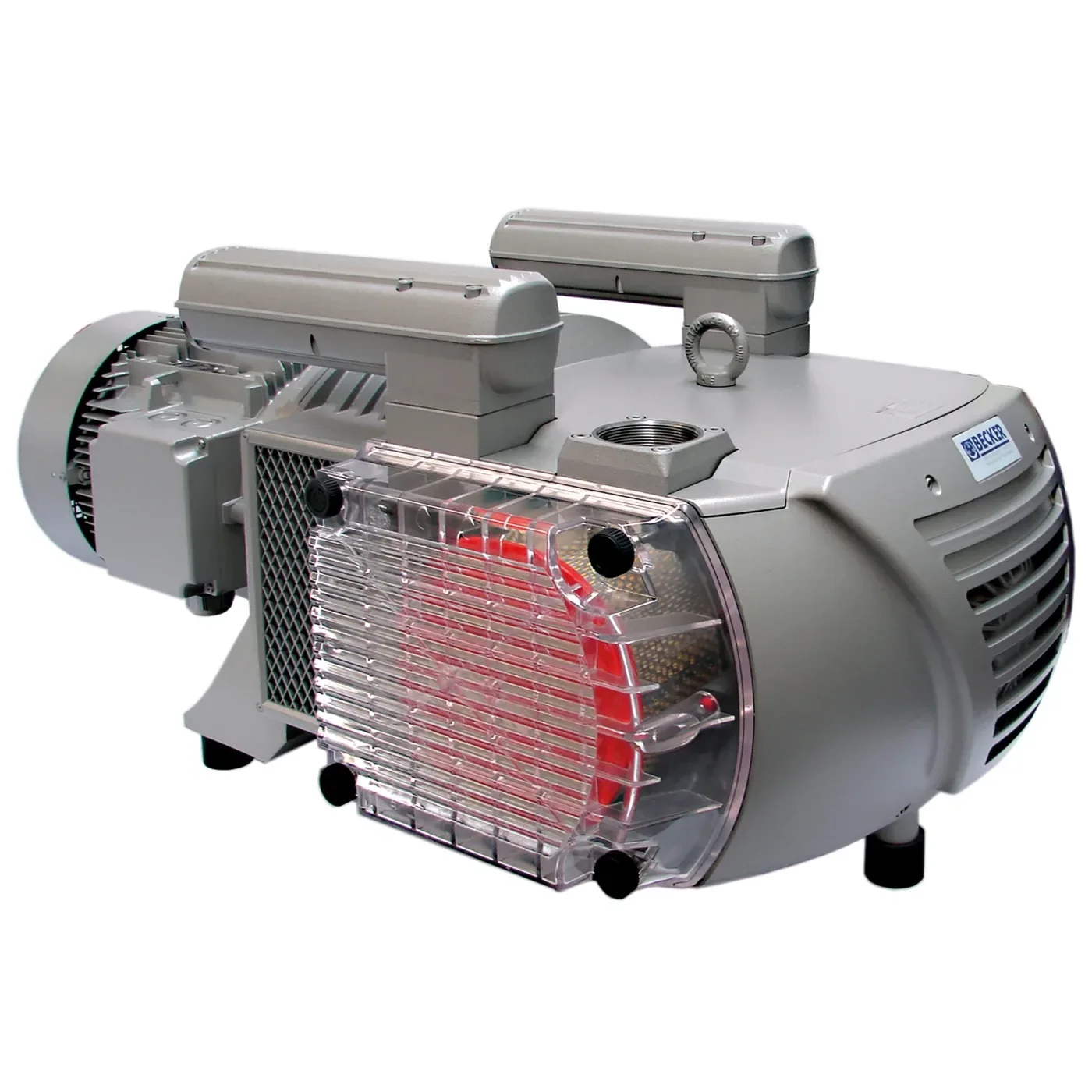
BECKER VTLF 2.200
High-flow dry-vane vacuum pump for continuous duty, with a large inlet filter and air cooling.
Complete technical data
| Flow rate 50 Hz | 178 m³/h |
|---|---|
| Absolute vacuum 50 Hz | 200 mbar |
| Power 50 Hz | 4.0 kW |
| Sound level 50 Hz | 75.0 dB(A) |
| Flow rate 60 Hz | 218 m³/h |
| Absolute vacuum 60 Hz | 200 mbar |
| Power 60 Hz | 4.8 kW |
| Sound level 60 Hz | 77.0 dB(A) |
| Weight published | 151.0 kg without motor |
Dimensions and connection
Dimensions and connections may vary with motor, voltage, orientation, accessories and configuration. Always confirm against the drawing for the exact order number before fabricating a base frame or piping.
Technology
- 100% dry operation, oil-free compression chamber
- Self-lubricating graphite-composite vanes
- Air cooling
- Designed for continuous duty
Standard equipment
- Large inlet filter with transparent cover
- vacuum relief / safety valve
- Exhaust silencers
- Vibration isolators
BECKER VTLF 2.250
High-flow dry-vane vacuum pump for continuous duty, with a large inlet filter and air cooling.
Complete technical data
| Flow rate 50 Hz | 244 m³/h |
|---|---|
| Absolute vacuum 50 Hz | 200 mbar |
| Power 50 Hz | 5.5 kW |
| Sound level 50 Hz | 77.0 dB(A) |
| Flow rate 60 Hz | 286 m³/h |
| Absolute vacuum 60 Hz | 200 mbar |
| Power 60 Hz | 6.6 kW |
| Sound level 60 Hz | 79.0 dB(A) |
| Weight published | 151.0 kg without motor |
Dimensions and connection
Dimensions and connections may vary with motor, voltage, orientation, accessories and configuration. Always confirm against the drawing for the exact order number before fabricating a base frame or piping.
Technology
- 100% dry operation, oil-free compression chamber
- Self-lubricating graphite-composite vanes
- Air cooling
- Designed for continuous duty
Standard equipment
- Large inlet filter with transparent cover
- vacuum relief / safety valve
- Exhaust silencers
- Vibration isolators
BECKER VTLF 2.250 SK
High-flow dry-vane vacuum pump for continuous duty, with a large inlet filter and air cooling.
Complete technical data
| Flow rate 50 Hz | 247 m³/h |
|---|---|
| Absolute vacuum 50 Hz | 100 mbar |
| Power 50 Hz | 7.5 kW |
| Sound level 50 Hz | 77.0 dB(A) |
| Flow rate 60 Hz | 295 m³/h |
| Absolute vacuum 60 Hz | 100 mbar |
| Power 60 Hz | 9.0 kW |
| Sound level 60 Hz | 79.0 dB(A) |
| Weight published | 161.0 kg without motor |
Dimensions and connection
Dimensions and connections may vary with motor, voltage, orientation, accessories and configuration. Always confirm against the drawing for the exact order number before fabricating a base frame or piping.
Technology
- 100% dry operation, oil-free compression chamber
- Self-lubricating graphite-composite vanes
- Air cooling
- Designed for continuous duty
Standard equipment
- Large inlet filter with transparent cover
- vacuum relief / safety valve
- Exhaust silencers
- Vibration isolators
BECKER VTLF 2.360
High-flow dry-vane vacuum pump for continuous duty, with a large inlet filter and air cooling.
Complete technical data
| Flow rate 50 Hz | 351 m³/h |
|---|---|
| Absolute vacuum 50 Hz | 250 mbar |
| Power 50 Hz | 11.0 kW |
| Sound level 50 Hz | 80.5 dB(A) |
| Flow rate 60 Hz | 402 m³/h |
| Absolute vacuum 60 Hz | 350 mbar |
| Power 60 Hz | 13.2 kW |
| Sound level 60 Hz | 82.5 dB(A) |
| Weight published | 151.0 kg without motor |
Dimensions and connection
Dimensions and connections may vary with motor, voltage, orientation, accessories and configuration. Always confirm against the drawing for the exact order number before fabricating a base frame or piping.
Technology
- 100% dry operation, oil-free compression chamber
- Self-lubricating graphite-composite vanes
- Air cooling
- Designed for continuous duty
Standard equipment
- Large inlet filter with transparent cover
- vacuum relief / safety valve
- Exhaust silencers
- Vibration isolators
BECKER VTLF 2.400
High-flow dry-vane vacuum pump for continuous duty, with a large inlet filter and air cooling.
Complete technical data
| Flow rate 50 Hz | 390 m³/h |
|---|---|
| Absolute vacuum 50 Hz | 200 mbar |
| Power 50 Hz | 7.5 kW |
| Sound level 50 Hz | 77.0 dB(A) |
| Flow rate 60 Hz | 460 m³/h |
| Absolute vacuum 60 Hz | 200 mbar |
| Power 60 Hz | 9.0 kW |
| Sound level 60 Hz | 79.0 dB(A) |
| Weight published | 248.0 kg without motor |
Dimensions and connection
Dimensions and connections may vary with motor, voltage, orientation, accessories and configuration. Always confirm against the drawing for the exact order number before fabricating a base frame or piping.
Technology
- 100% dry operation, oil-free compression chamber
- Self-lubricating graphite-composite vanes
- Air cooling
- Designed for continuous duty
Standard equipment
- Large inlet filter with transparent cover
- vacuum relief / safety valve
- Exhaust silencers
- Vibration isolators
BECKER VTLF 2.500
High-flow dry-vane vacuum pump for continuous duty, with a large inlet filter and air cooling.
Complete technical data
| Flow rate 50 Hz | 495 m³/h |
|---|---|
| Absolute vacuum 50 Hz | 250 mbar |
| Power 50 Hz | 11.0 kW |
| Sound level 50 Hz | 79.0 dB(A) |
| Flow rate 60 Hz | 570 m³/h |
| Absolute vacuum 60 Hz | 250 mbar |
| Power 60 Hz | 13.2 kW |
| Sound level 60 Hz | 80.0 dB(A) |
| Weight published | 248.0 kg without motor |
Dimensions and connection
Dimensions and connections may vary with motor, voltage, orientation, accessories and configuration. Always confirm against the drawing for the exact order number before fabricating a base frame or piping.
Technology
- 100% dry operation, oil-free compression chamber
- Self-lubricating graphite-composite vanes
- Air cooling
- Designed for continuous duty
Standard equipment
- Large inlet filter with transparent cover
- vacuum relief / safety valve
- Exhaust silencers
- Vibration isolators
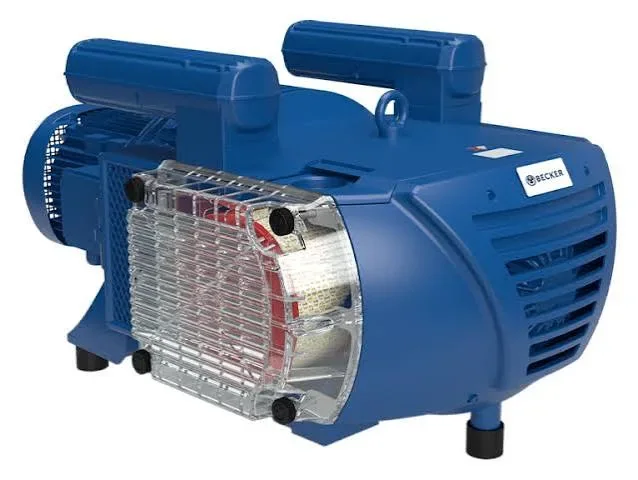
BECKER VXLF 2.200
Dry X Series pump Xhigh-flow dry-vane pump for continuous duty, with extended-service-life vanes and integrated inlet filtration.
Complete technical data
| Flow rate 50 Hz | 178 m³/h |
|---|---|
| Absolute vacuum 50 Hz | 200 mbar |
| Power 50 Hz | 4.0 kW |
| Sound level 50 Hz | 75.0 dB(A) |
| Flow rate 60 Hz | 218 m³/h |
| Absolute vacuum 60 Hz | 200 mbar |
| Power 60 Hz | 4.8 kW |
| Sound level 60 Hz | 77.0 dB(A) |
| Weight published | 151.0 kg without motor |
Dimensions and connection
The public web data does not show dimensions/connections for this configuration. Request the dimensional drawing for the exact order number before defining the base frame or piping.
Technology
- 100% dry operation, oil-free compression chamber
- Self-lubricating graphite-composite vanes
- Series X: vanes designed for an extended service life of up to 20,000 h
- Air cooling
- Designed for continuous duty
Standard equipment
- Large inlet filter with transparent cover
- vacuum relief / safety valve
- Exhaust silencers
- Vibration isolators
BECKER VXLF 2.250
Dry X Series pump Xhigh-flow dry-vane pump for continuous duty, with extended-service-life vanes and integrated inlet filtration.
Complete technical data
| Flow rate 50 Hz | 244 m³/h |
|---|---|
| Absolute vacuum 50 Hz | 200 mbar |
| Power 50 Hz | 5.5 kW |
| Sound level 50 Hz | 77.0 dB(A) |
| Flow rate 60 Hz | 286 m³/h |
| Absolute vacuum 60 Hz | 200 mbar |
| Power 60 Hz | 6.6 kW |
| Sound level 60 Hz | 79.0 dB(A) |
| Weight published | 151.0 kg without motor |
Dimensions and connection
The public web data does not show dimensions/connections for this configuration. Request the dimensional drawing for the exact order number before defining the base frame or piping.
Technology
- 100% dry operation, oil-free compression chamber
- Self-lubricating graphite-composite vanes
- Series X: vanes designed for an extended service life of up to 20,000 h
- Air cooling
- Designed for continuous duty
Standard equipment
- Large inlet filter with transparent cover
- vacuum relief / safety valve
- Exhaust silencers
- Vibration isolators
BECKER VXLF 2.250 SK
Dry X Series pump Xhigh-flow dry-vane pump for continuous duty, with extended-service-life vanes and integrated inlet filtration.
Complete technical data
| Flow rate 50 Hz | 247 m³/h |
|---|---|
| Absolute vacuum 50 Hz | 100 mbar |
| Power 50 Hz | 7.5 kW |
| Sound level 50 Hz | 77.0 dB(A) |
| Flow rate 60 Hz | 295 m³/h |
| Absolute vacuum 60 Hz | 100 mbar |
| Power 60 Hz | 9.0 kW |
| Sound level 60 Hz | 79.0 dB(A) |
| Weight published | 161.0 kg without motor |
Dimensions and connection
The public web data does not show dimensions/connections for this configuration. Request the dimensional drawing for the exact order number before defining the base frame or piping.
Technology
- 100% dry operation, oil-free compression chamber
- Self-lubricating graphite-composite vanes
- Series X: vanes designed for an extended service life of up to 20,000 h
- Air cooling
- Designed for continuous duty
Standard equipment
- Large inlet filter with transparent cover
- vacuum relief / safety valve
- Exhaust silencers
- Vibration isolators
BECKER VXLF 2.400
Dry X Series pump Xhigh-flow dry-vane pump for continuous duty, with extended-service-life vanes and integrated inlet filtration.
Complete technical data
| Flow rate 50 Hz | 390 m³/h |
|---|---|
| Absolute vacuum 50 Hz | 200 mbar |
| Power 50 Hz | 7.5 kW |
| Sound level 50 Hz | 77.0 dB(A) |
| Flow rate 60 Hz | 460 m³/h |
| Absolute vacuum 60 Hz | 200 mbar |
| Power 60 Hz | 9.0 kW |
| Sound level 60 Hz | 79.0 dB(A) |
| Weight published | 248.0 kg without motor |
Dimensions and connection
The public web data does not show dimensions/connections for this configuration. Request the dimensional drawing for the exact order number before defining the base frame or piping.
Technology
- 100% dry operation, oil-free compression chamber
- Self-lubricating graphite-composite vanes
- Series X: vanes designed for an extended service life of up to 20,000 h
- Air cooling
- Designed for continuous duty
Standard equipment
- Large inlet filter with transparent cover
- vacuum relief / safety valve
- Exhaust silencers
- Vibration isolators
BECKER VXLF 2.500
Dry X Series pump Xhigh-flow dry-vane pump for continuous duty, with extended-service-life vanes and integrated inlet filtration.
Complete technical data
| Flow rate 50 Hz | 495 m³/h |
|---|---|
| Absolute vacuum 50 Hz | 250 mbar |
| Power 50 Hz | 11.0 kW |
| Sound level 50 Hz | 79.0 dB(A) |
| Flow rate 60 Hz | 570 m³/h |
| Absolute vacuum 60 Hz | 250 mbar |
| Power 60 Hz | 13.2 kW |
| Sound level 60 Hz | 80.0 dB(A) |
| Weight published | 248.0 kg without motor |
Dimensions and connection
The public web data does not show dimensions/connections for this configuration. Request the dimensional drawing for the exact order number before defining the base frame or piping.
Technology
- 100% dry operation, oil-free compression chamber
- Self-lubricating graphite-composite vanes
- Series X: vanes designed for an extended service life of up to 20,000 h
- Air cooling
- Designed for continuous duty
Standard equipment
- Large inlet filter with transparent cover
- vacuum relief / safety valve
- Exhaust silencers
- Vibration isolators
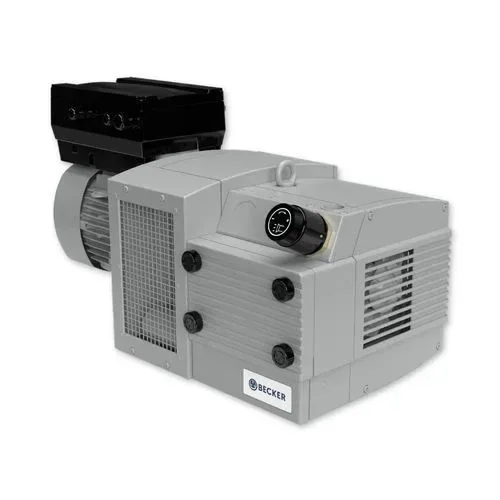
BECKER VARIAIR KVT 3.80/0-400
dry-vane pump with VARIAIR frequency control to match flow to variable vacuum demand.
Complete technical data
| Flow rate published | 76 m³/h |
|---|---|
| Absolute vacuum | 100 mbar |
| Converter power | 4.0 kW |
| Frequency range | 30…60 Hz |
| Sound level | 67.0 dB(A) |
| Weight published | 88.5 kg with motor and inverter |
Dimensions and connection
The public web data does not show dimensions/connections for this configuration. Request the dimensional drawing for the exact order number before defining the base frame or piping.
Technology
- 100% dry operation, oil-free compression chamber
- Self-lubricating graphite-composite vanes
- Air cooling
- Designed for continuous duty
- Speed control using converter VARIAIR, 30…60 Hz
Standard equipment
- Frequency converter VARIAIR
- Large integrated inlet filter
- vacuum relief / safety valve
- Exhaust silencers
- Vibration isolators
BECKER VARIAIR KVT 3.100/0-400
dry-vane pump with VARIAIR frequency control to match flow to variable vacuum demand.
Complete technical data
| Flow rate published | 112 m³/h |
|---|---|
| Absolute vacuum | 100 mbar |
| Converter power | 4.0 kW |
| Frequency range | 30…60 Hz |
| Sound level | 77.0 dB(A) |
| Weight published | 109.5 kg with motor and inverter |
Dimensions and connection
Dimensions and connections may vary with motor, voltage, orientation, accessories and configuration. Always confirm against the drawing for the exact order number before fabricating a base frame or piping.
Technology
- 100% dry operation, oil-free compression chamber
- Self-lubricating graphite-composite vanes
- Air cooling
- Designed for continuous duty
- Speed control using converter VARIAIR, 30…60 Hz
Standard equipment
- Frequency converter VARIAIR
- Large integrated inlet filter
- vacuum relief / safety valve
- Exhaust silencers
- Vibration isolators
BECKER VARIAIR KVT 3.140/0-400
dry-vane pump with VARIAIR frequency control to match flow to variable vacuum demand.
Complete technical data
| Flow rate published | 145 m³/h |
|---|---|
| Absolute vacuum | 100 mbar |
| Converter power | 4.0 kW |
| Frequency range | 30…60 Hz |
| Sound level | 77.9 dB(A) |
| Weight published | 115.5 kg with motor and inverter |
Dimensions and connection
Dimensions and connections may vary with motor, voltage, orientation, accessories and configuration. Always confirm against the drawing for the exact order number before fabricating a base frame or piping.
Technology
- 100% dry operation, oil-free compression chamber
- Self-lubricating graphite-composite vanes
- Air cooling
- Designed for continuous duty
- Speed control using converter VARIAIR, 30…60 Hz
Standard equipment
- Frequency converter VARIAIR
- Large integrated inlet filter
- vacuum relief / safety valve
- Exhaust silencers
- Vibration isolators
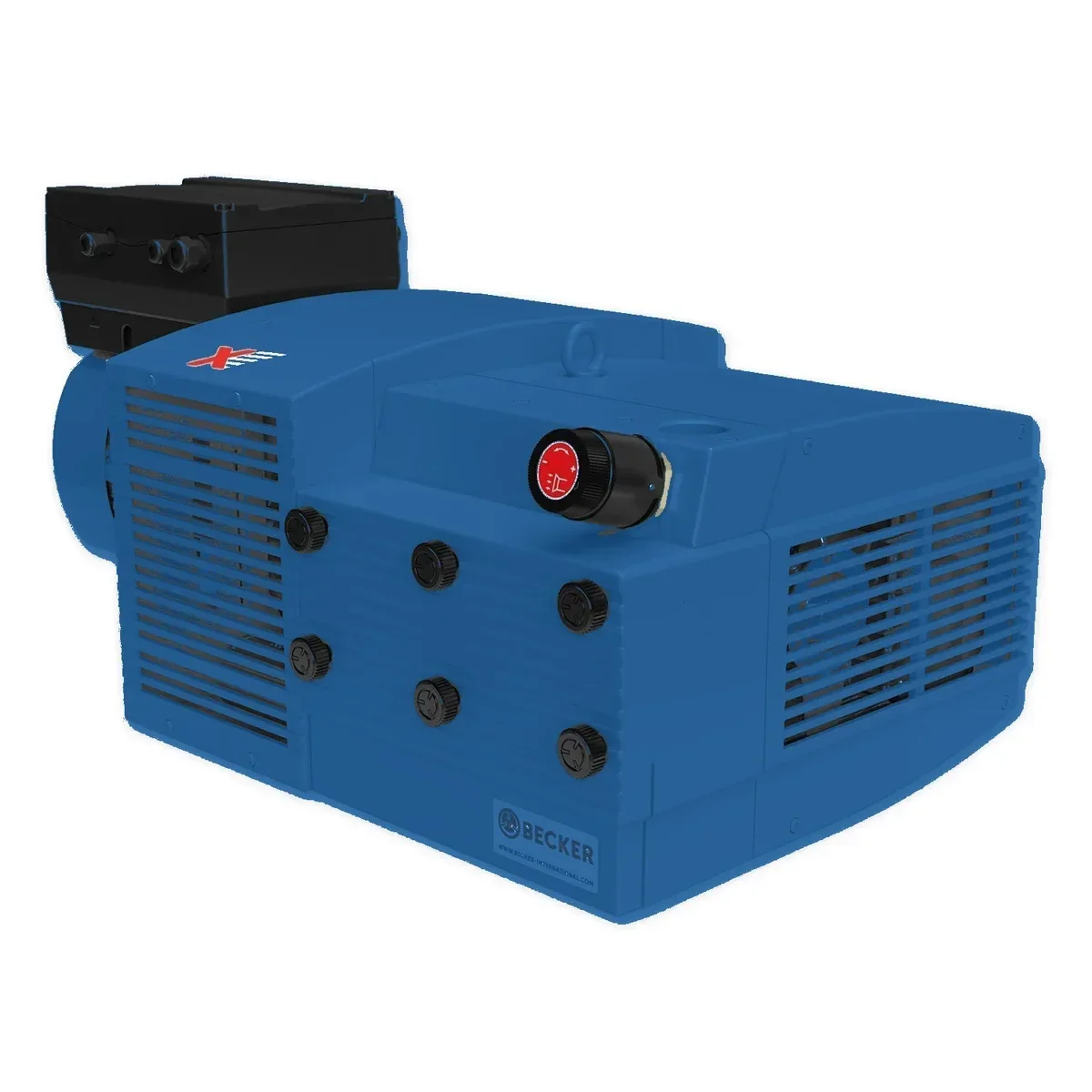
BECKER VARIAIR KVX 3.80/0-400
Series pump XDry-vane configuration with VARIAIR frequency control for continuous operation.
Complete technical data
| Flow rate published | 76 m³/h |
|---|---|
| Absolute vacuum | 100 mbar |
| Converter power | 4.0 kW |
| Frequency range | 30…60 Hz |
| Sound level | 67.0 dB(A) |
| Weight published | 88.5 kg with motor and inverter |
Dimensions and connection
The public web data does not show dimensions/connections for this configuration. Request the dimensional drawing for the exact order number before defining the base frame or piping.
Technology
- 100% dry operation, oil-free compression chamber
- Self-lubricating graphite-composite vanes
- Air cooling
- Designed for continuous duty
- Speed control using converter VARIAIR, 30…60 Hz
Standard equipment
- Frequency converter VARIAIR
- Large integrated inlet filter
- vacuum relief / safety valve
- Exhaust silencers
- Vibration isolators
BECKER VARIAIR KVX 3.100/0-400
Series pump XDry-vane configuration with VARIAIR frequency control for continuous operation.
Complete technical data
| Flow rate published | 112 m³/h |
|---|---|
| Absolute vacuum | 100 mbar |
| Converter power | 4.0 kW |
| Frequency range | 30…60 Hz |
| Sound level | 77.0 dB(A) |
| Weight published | 109.5 kg with motor and inverter |
Dimensions and connection
The public web data does not show dimensions/connections for this configuration. Request the dimensional drawing for the exact order number before defining the base frame or piping.
Technology
- 100% dry operation, oil-free compression chamber
- Self-lubricating graphite-composite vanes
- Air cooling
- Designed for continuous duty
- Speed control using converter VARIAIR, 30…60 Hz
Standard equipment
- Frequency converter VARIAIR
- Large integrated inlet filter
- vacuum relief / safety valve
- Exhaust silencers
- Vibration isolators
BECKER VARIAIR KVX 3.140/0-400
Series pump XDry-vane configuration with VARIAIR frequency control for continuous operation.
Complete technical data
| Flow rate published | 145 m³/h |
|---|---|
| Absolute vacuum | 100 mbar |
| Converter power | 4.0 kW |
| Frequency range | 30…60 Hz |
| Sound level | 77.9 dB(A) |
| Weight published | 115.5 kg with motor and inverter |
Dimensions and connection
The public web data does not show dimensions/connections for this configuration. Request the dimensional drawing for the exact order number before defining the base frame or piping.
Technology
- 100% dry operation, oil-free compression chamber
- Self-lubricating graphite-composite vanes
- Air cooling
- Designed for continuous duty
- Speed control using converter VARIAIR, 30…60 Hz
Standard equipment
- Frequency converter VARIAIR
- Large integrated inlet filter
- vacuum relief / safety valve
- Exhaust silencers
- Vibration isolators
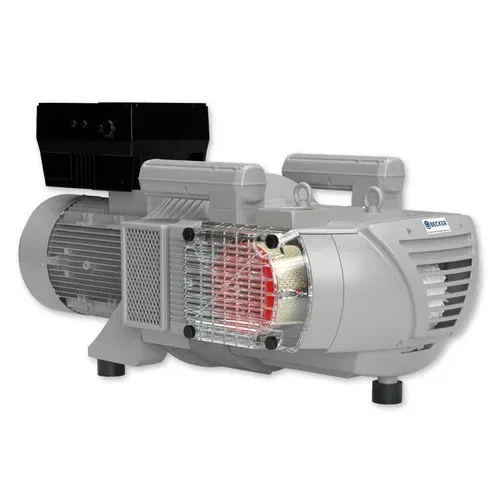
BECKER VARIAIR VTLF 2.250/0-400
high-flow dry-vane pump with a VARIAIR frequency converter for speed control.
Complete technical data
| Flow rate published | 280 m³/h |
|---|---|
| Absolute vacuum | 200 mbar |
| Converter power | 7.5 kW |
| Frequency range | 30…60 Hz |
| Sound level | 79.0 dB(A) |
| Weight published | 270.0 kg with motor and inverter |
Dimensions and connection
Dimensions and connections may vary with motor, voltage, orientation, accessories and configuration. Always confirm against the drawing for the exact order number before fabricating a base frame or piping.
Technology
- 100% dry operation, oil-free compression chamber
- Self-lubricating graphite-composite vanes
- Air cooling
- Designed for continuous duty
- Speed control using converter VARIAIR, 30…60 Hz
Standard equipment
- Frequency converter VARIAIR
- Large integrated inlet filter
- vacuum relief / safety valve
- Exhaust silencers
- Vibration isolators
BECKER VARIAIR VTLF 2.360/0-400
high-flow dry-vane pump with a VARIAIR frequency converter for speed control.
Complete technical data
| Reference flow rate | 405 m³/h |
|---|---|
| Reference absolute vacuum | 250 mbar |
| Reference converter power | 11.0…22.0 kW |
| Reference frequency range | 30…60 Hz |
| Reference weight | 290.0 kg with motor and inverter |
Dimensions and connection
Dimensions and connections may vary with motor, voltage, orientation, accessories and configuration. Always confirm against the drawing for the exact order number before fabricating a base frame or piping.
Reference configuration: confirm availability, execution and current technical data before quoting. No unverified sound level is published here.
BECKER VARIAIR VTLF 2.500/0-400
high-flow dry-vane pump with a VARIAIR frequency converter for speed control.
Complete technical data
| Flow rate published | 560 m³/h |
|---|---|
| Absolute vacuum | 250 mbar |
| Converter power | 11.0…22.0 kW |
| Frequency range | 30…60 Hz |
| Sound level | 80.0 dB(A) |
| Weight published | 445.0 kg with motor and inverter |
Dimensions and connection
Dimensions and connections may vary with motor, voltage, orientation, accessories and configuration. Always confirm against the drawing for the exact order number before fabricating a base frame or piping.
Technology
- 100% dry operation, oil-free compression chamber
- Self-lubricating graphite-composite vanes
- Air cooling
- Designed for continuous duty
- Speed control using converter VARIAIR, 30…60 Hz
Standard equipment
- Frequency converter VARIAIR
- Large integrated inlet filter
- vacuum relief / safety valve
- Exhaust silencers
- Vibration isolators
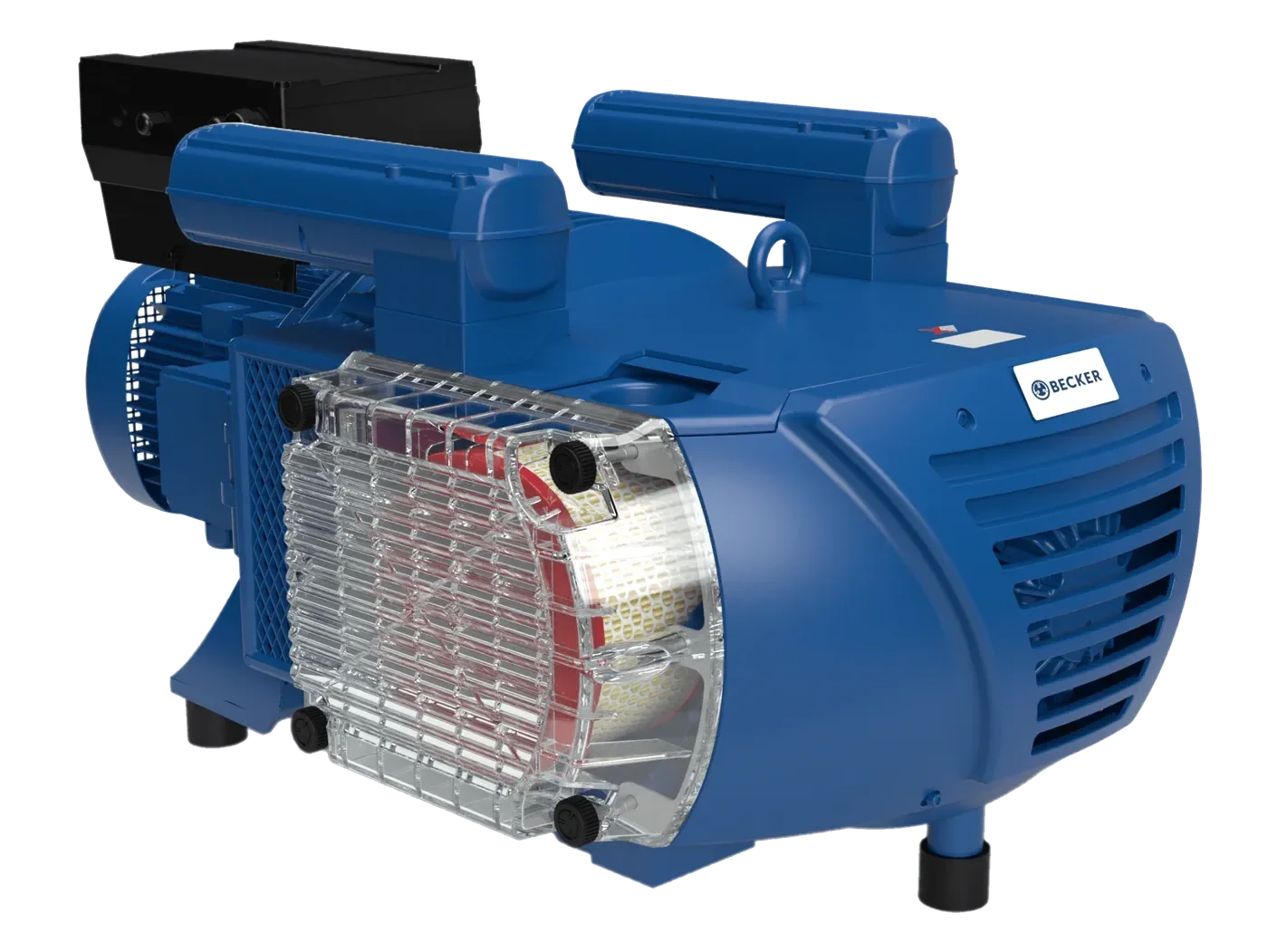
BECKER VARIAIR VXLF 2.250/0-400
Series pump Xhigh-flow configuration with VARIAIR converter and speed control between 30 and 60 Hz.
Complete technical data
| Flow rate published | 280 m³/h |
|---|---|
| Absolute vacuum | 200 mbar |
| Converter power | 7.5 kW |
| Frequency range | 30…60 Hz |
| Sound level | 79.0 dB(A) |
| Weight published | 270.0 kg with motor and inverter |
Dimensions and connection
The public web data does not show dimensions/connections for this configuration. Request the dimensional drawing for the exact order number before defining the base frame or piping.
Technology
- 100% dry operation, oil-free compression chamber
- Self-lubricating graphite-composite vanes
- Air cooling
- Designed for continuous duty
- Speed control using converter VARIAIR, 30…60 Hz
Standard equipment
- Frequency converter VARIAIR
- Large integrated inlet filter
- vacuum relief / safety valve
- Exhaust silencers
- Vibration isolators
BECKER VARIAIR VXLF 2.500/0-400
Series pump Xhigh-flow configuration with VARIAIR converter and speed control between 30 and 60 Hz.
Complete technical data
| Flow rate published | 560 m³/h |
|---|---|
| Absolute vacuum | 250 mbar |
| Converter power | 11.0…22.0 kW |
| Frequency range | 30…60 Hz |
| Sound level | 80.0 dB(A) |
| Weight published | 445.0 kg with motor and inverter |
Dimensions and connection
The public web data does not show dimensions/connections for this configuration. Request the dimensional drawing for the exact order number before defining the base frame or piping.
Technology
- 100% dry operation, oil-free compression chamber
- Self-lubricating graphite-composite vanes
- Air cooling
- Designed for continuous duty
- Speed control using converter VARIAIR, 30…60 Hz
Standard equipment
- Frequency converter VARIAIR
- Large integrated inlet filter
- vacuum relief / safety valve
- Exhaust silencers
- Vibration isolators
Need to compare two BECKER models?
Send us the models, voltage, frequency and application so we can review the most suitable option.
Industrial applications of BECKER dry-vane vacuum pumps
BECKER dry-vane technology is used for holding, handling, evacuation, extraction and pneumatic conveying. The industry helps define the application, but it does not determine the model by itself: selection must be based on the required flow at the actual operating vacuum, leakage, duty cycle, gas quality and installation losses.
 01
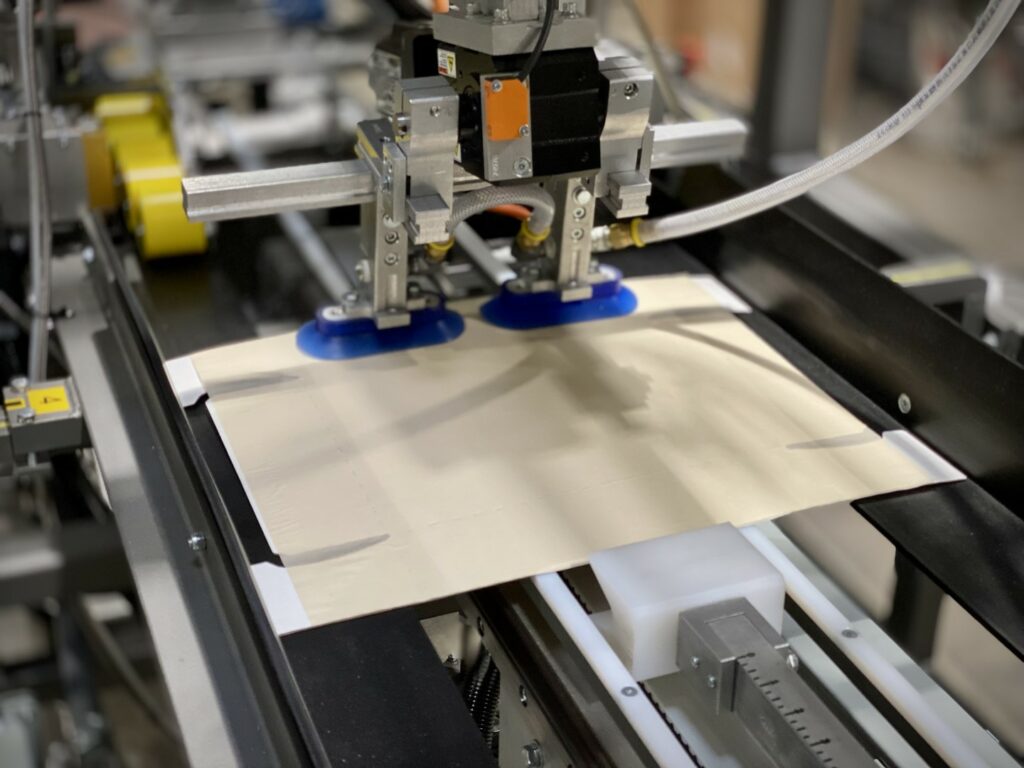
01Secondary packaging and automation
Vacuum for packaging, container feeding and automated handling
BECKER dry-vane vacuum pumps are used on packaging lines to position products, open bags, feed containers and support automated suction-cup handling stations.
Technical criteria for sizing this application
In these machines, the ability to recover vacuum quickly after each pick is often more important than ultimate vacuum alone. Sizing should account for suction-cup and piping volume, expected leakage, surface material, simultaneous axes and cycle frequency. This application should be distinguished from chamber packaging or processes requiring deep vacuum or handling high vapour loads, which may need different technology. If demand varies significantly during the cycle, a VARIAIR solution may be attractive after the real demand profile has been defined.
Families to consider: VT, KVT, VTLF and controlled variants, always according to the actual duty point.
 02
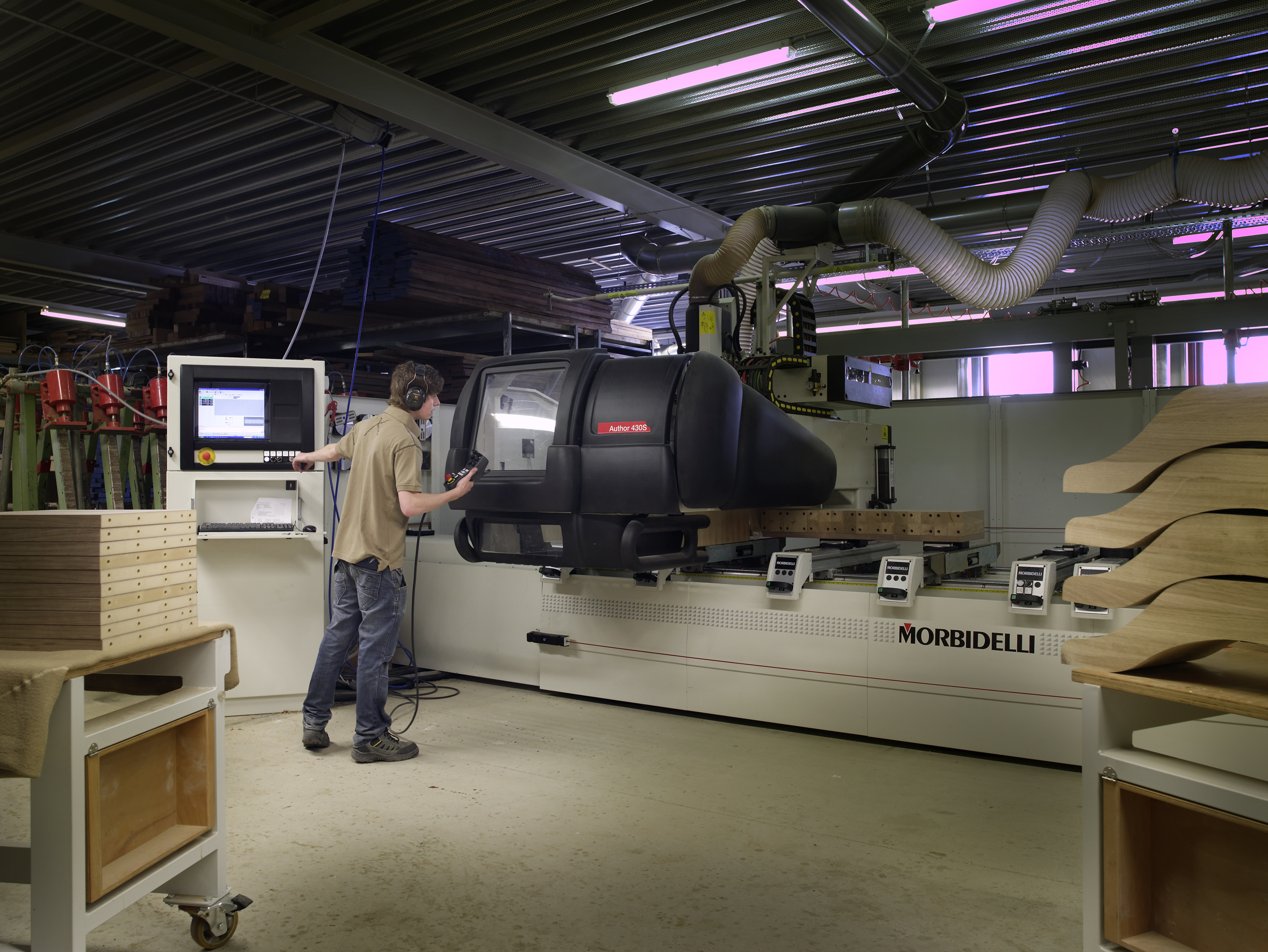
02Woodworking, CNC and nesting
Vacuum holding for CNC, nesting and machining tables
In machining centres, nesting tables and woodworking processes, BECKER dry vacuum is used to hold panels, boards and parts with stability, repeatability and low maintenance requirements.
Technical criteria for sizing this application
BECKER explicitly documents dry-vane technology in woodworking and highlights the X Series — VX, KVX and VXLF — for demanding dry-vacuum duty; VARIAIR can also be considered when demand fluctuates. To size a CNC vacuum table, define the working surface, number of zones, sacrificial-board porosity, manifold diameter and length, filtration and permissible pressure losses. Fine dust is a critical service factor: inadequate filtration can reduce performance and accelerate wear. Select on the flow required at the actual holding pressure, not on nominal flow alone.
Strong BECKER application context: VTLF/VXLF, KVX and VARIAIR solutions, depending on flow rate and demand variation.
 03
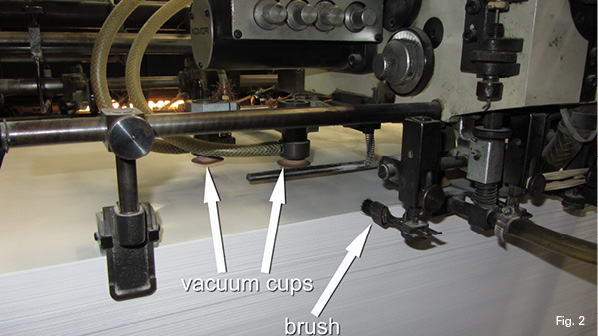
03Printing and paper
Vacuum for sheet feeding, separation and transport
BECKER applies dry vacuum to sheet feeding, separation, transport and paper handling in offset printing equipment and processes where precise pickup and movement are critical.
Technical criteria for sizing this application
An important point in printing machinery is that the process may require both vacuum and blow air. If the pneumatic architecture needs both functions, a vacuum-only pump may not be the correct solution and combined systems or compressors should be considered. For the vacuum side, evaluate paper format and weight, number of suction cups, feed frequency, leakage, hose length and dust sensitivity. BECKER includes oil-free rotary-vane pumps for printing and paper applications; the specific family depends on the required flow and vacuum level.
Before selecting a model, confirm whether the machine requires vacuum only or a combined vacuum-and-blow-air system.
 04
04Plastics and thermoforming
Rapid evacuation for thermoforming and sheet holding
In thermoforming, deep drawing and certain moulding operations, BECKER dry pumps help evacuate chambers and moulds rapidly to stabilize the process and improve repeatability.
Technical criteria for sizing this application
Sizing must start from the volume to be evacuated, initial and final pressure, available evacuation time, piping conductance, mould tightness and intake-gas temperature. For sheet holding during cutting or machining, leakage compensation can become more important than initial evacuation. Clean air must also be distinguished from vapours or entrained material. Dry pumps perform best with properly conditioned gas; if condensate, plasticizers or particles may be drawn in, suitable separation and filtration should be added or another technology considered.
There is no single family for thermoforming: volume and cycle time determine the required flow.
 05
05Pick & Place and robotics
Vacuum for robots, suction cups and handling of components
In robotic cells, gantries and handling systems, BECKER supplies Vacuum for suction cups, fast pickup and Pick & Place operations with simple integration and clean oil-free operation.
Technical criteria for sizing this application
BECKER specifically presents the VT and KVT series for Pick & Place applications. The calculation should consider the effective area of each suction cup, part material and surface roughness, acceleration, load orientation, internal volume, leakage and simultaneity. Sensors, check valves and, where appropriate, a small buffer receiver can improve system reliability. If demand changes substantially between standby and handling states, speed control can improve efficiency. Final model selection must be based on flow at operating pressure, not motor power alone.
BECKER documents VT and KVT for Pick & Place; other families may be required if flow demand or system architecture changes.
 06
06Medical technology
Extraction and suction in medical-technology equipment and systems
BECKER solutions are used in medical-technology equipment where extraction, suction or vacuum support must combine clean operation, stability and low maintenance.
Technical criteria for sizing this application
An industrial pump alone is not equivalent to a certified medical vacuum system. The integrator must verify regulatory requirements, redundancy, filtration, liquid separation, alarms, gas quality, material compatibility and maintenance strategy. Medical or OEM equipment must also consider noise, vibration, space, ventilation and service access. Where liquids or aerosols may enter the suction line, they must be prevented from reaching the pump. Exportvacio can support vacuum-generator selection, while sanitary and functional validation remains the responsibility of the final-system manufacturer or integrator.
Application depends on the final system: select the pump and validate medical requirements separately.
 07
07Environment and wastewater
Vacuum for drainage in sewer systems and environmental processes
In environmental engineering, BECKER technology can be used to generate low pressure for vacuum-sewer drainage and the transport of wastewater and air/fluid mixtures. Sizing depends on the network, air ingress, simultaneity and actual operating conditions.
Technical criteria for sizing this application
Vacuum sewer systems use a pressure differential to move wastewater toward collection or treatment stations. Selection must consider piping length and geometry, valve-opening frequency, air ingress, simultaneous flow and protection against liquid carry-over.
Conditional selection: confirm that gas reaches the pump without liquid carryover and within the permissible temperature range.
 08
08Pneumatic conveying
Vacuum for conveying powders, granules and bulk solids
BECKER covers pneumatic conveying applications where vacuum moves powders, granules and bulk solids with controlled flow, clean process handling and adaptation to different installations.
Technical criteria for sizing this application
The calculation must relate product type and density to solids throughput, piping diameter and length, elevation, number of bends, filters and pressure losses. Excessive conveying velocity can degrade product, erode piping or increase energy use; insufficient velocity can cause settling and blockages. Receiver-filter loading changes the operating point over time. Before selecting a BECKER pump, define the required air flow and vacuum in the most demanding scenario and confirm that both product and gas are compatible with dry-vane technology.
Sizing is a system-level exercise: a larger pump does not correct undersized piping or a poorly selected filter.
 09
09Electronics and precision
Holding, testing and Pick & Place of electronic components
In electronics, BECKER vacuum pumps are used for test holding, handling boards and components, and Pick & Place processes that demand precision, low vibration and stable response.
Technical criteria for sizing this application
The designer should specify required vacuum, flow, leakage, part sensitivity, permissible vibration, sound level, enclosure temperature and service access to filters and vanes. In clean-room component handling, exhaust architecture and thermal management must be assessed as part of the complete system. BECKER also documents electronic-component Pick & Place in centralized systems. For OEM machinery supplied to Africa, Asia and the Middle East, voltage, frequency, altitude, ambient temperature and destination operating conditions should be confirmed at order stage.
For electronic Pick & Place, VT/KVT can be suitable candidates; final integration depends on flow, noise and the operating environment.
Six inputs for selecting a BECKER pump
Two machines in the same industry can require very different pumps. To quote correctly, convert the process into measurable data before comparing VT, VX, KVT, KVX, VTLF, VXLF or VARIAIR.
What is being held, evacuated, extracted or conveyed, and how many consumers operate at the same time.
Flow rate in m³/h or capacity required at the operating point.
Actual absolute pressure that must be maintained during the process.
Porosity, dust, moisture, vapours, droplets and required filtration.
evacuation time, cycles per hour and consumers operating simultaneously.
Voltage, frequency, altitude, ambient temperature and VARIAIR control where applicable.
Applied engineering for BECKER dry-vane vacuum pumps
Selecting a pump is not a matter of choosing the highest flow or the lowest vacuum value. The correct model emerges when the process is converted into a measurable duty point: absolute pressure, useful flow, leakage, duty cycle, gas quality and actual installation conditions.
Sizing starts with the process, not with the BECKER reference
The BECKER dry range covers multiple flow and vacuum levels. To narrow down the correct family, first define what the system must do and under which conditions. Then compare the duty point with the model data sheet and validate the installation.
Flow rate indicates how much gas the system moves; vacuum indicates the pressure that must be maintained.
To compare data sheets and process requirements, use mbar absolute and avoid mixing absolute and gauge values.
Piping, filters, valves, leakage and contamination change the performance available at the machine.
Six variables before selecting the pump
If any of these data are missing, selection becomes an estimate. The more accurately the process is described, the more reliable the choice of size, family and electrical configuration.
Vacuum function
Hold, evacuate, extract, convey or handle; identify all consumers and the system volume.
Operating pressure
Required vacuum expressed as absolute pressure during the actual cycle.
Useful flow rate
Flow rate required at the operating pressure, not only nominal flow at free-air conditions.
Leaks and gas quality
Porosity, dust, moisture, vapours, condensation and required filtration level.
Duty cycle and simultaneity
Evacuation time, service hours, starts and consumers operating simultaneously.
Installation conditions
Voltage, frequency, ambient temperature, altitude, ventilation, piping and backpressure.
From process to BECKER model in five steps
The family is selected after defining the duty point. The model is then validated against system losses, installation conditions and gas quality.
Three signals to stop the calculation and review the process
A correctly selected pump can still perform poorly if it is operated outside the conditions for which it was sized.
Dry-vane pumps are designed for gases suitable for dry operation. If liquid can reach the pump, protect the pump or consider another technology.
Contamination affects filters, vane wear and available flow. Inlet protection must form part of the sizing process.
Do not select a pump by motor power alone. If the process requires a pressure below the capability of the dry-vane family, another BECKER technology should be evaluated.
How BECKER dry-vane vacuum pumps operate
A BECKER dry-vane pump generates vacuum by moving gas from the inlet to the exhaust with an eccentric rotor and sliding vanes. The mechanical principle is simple, but actual performance depends on the duty point, intake gas, leakage, installation and filtration condition.
Vacuum is generated by increasing chamber volume, drawing in gas, transporting it and discharging it
The rotor rotates eccentrically within the chamber, so the clearance between rotor and housing changes continuously. The vanes slide and form chambers of variable volume: gas is drawn in, isolated, compressed and discharged. Because there is no process oil in the compression chamber, the pump operates dry and relies on self-lubricating vanes and suitable inlet-gas quality.
The four phases of one rotor revolution
The principle is continuous: each chamber between two vanes passes through these four phases as the rotor turns.
Suction
When the space between rotor, housing and two vanes increases, local pressure drops and gas enters through the inlet port.
Isolation and transport
The vanes isolate that gas volume and carry it around the housing as the rotor continues to turn.
Compression
The eccentric geometry causes the trapped volume to decrease; as it decreases, gas pressure rises.
Discharge
When chamber pressure exceeds exhaust pressure, the gas leaves through the outlet. The next chamber repeats the cycle continuously.
Components directly involved in vacuum generation
Understanding these components helps interpret maintenance, wear and operating behaviour.
The rotor is the driving element; its eccentric rotation creates the geometric change in chamber volume.
They slide within the rotor slots and form partially sealed chambers that transport gas.
Defines the path and the chamber volume that changes during rotation.
Connection through which gas enters from the installation or application.
Area where compressed gas is discharged from the pump.
They affect service life, performance stability and protection against dust or particles.
Why the same pump performs differently depending on the application
The pump does not operate in isolation: the complete installation determines actual vacuum performance.
The closer the pump operates to the maximum vacuum of the series, the lower the available flow will generally be.
The pump must deliver the required flow at the actual process pressure, not only at free air.
Suction cups, porous tables, gaskets or fixtures with leakage can change sizing completely.
Moisture, condensables, dust or aerosols can affect the suitability of dry-vane technology.
Piping length, loaded filters and pressure losses change the operating point.
Continuous duty, intermittent service or variable demand affect temperature and stability.
What “dry pump” means — and what it does not imply
In a dry pump, the gas does not require oil inside the compression chamber, but that does not mean the pump is suitable for every gas or every vacuum level. The technology must match the process.
What defines a BECKER dry-vane pump
- There is no process oil in the compression chamber.
- Self-lubricating vanes provide the dynamic sealing required to move gas.
- The architecture is compact and suitable for many industrial dry-vacuum applications.
- Maintenance focuses on filters, vanes, cleaning, ventilation and system verification.
What must not be assumed automatically
- That every dry pump is suitable for gases containing liquid, condensate or severe contamination.
- That a larger motor always means a better technical selection.
- That nominal flow will remain unchanged at every operating vacuum level.
- That one family covers every operating point simply because it serves the same market.
Technical comparison of BECKER VT, VX, KVT, KVX, VTLF, VXLF and VARIAIR families
The correct family is not determined by external size or motor power. It is determined by required flow at the duty point, absolute vacuum, service severity, maintenance strategy and, when demand varies, the need for speed control.
VX, KVX and VXLF: X Series for demanding industrial service
The seriesXThe X Series concentrates BECKER's long-service-life approach within the dry-vane families. BECKER publishes a graphite-composite vane design life of up to 20,000 hours for VX, KVX and VXLF. This is not a universal service-life guarantee: actual life depends on operating vacuum, filtration, temperature, intake gas, installation and maintenance.
Start with the process: the family helps narrow the selection
BECKER groups its dry range by flow-rate scale, vacuum level and architecture. The X Series — VX, KVX and VXLF — adds BECKER’s published extended-service-life vane strategy. VARIAIR adds frequency control to match speed when demand is variable.
Required vacuum
Work in mbar absolute and validate the operating limit of the series.
Useful flow rate
Compare the required flow at the actual process pressure.
Service strategy
Evaluate access, filtration, vanes and the criticality of downtime.
Demand variation
If demand changes significantly, evaluate VARIAIR after defining the actual demand profile.
| Family | Flow rate published | Absolute vacuum | Architecture / focus | When to assess it first |
|---|---|---|---|---|
| VT | 1.9–48 m³/h | 150–400 mbar | Compact · fixed speed | Compact machines, dry vacuum and low/medium demand. |
| VXHIGH PERFORMANCE | 10–48 m³/h | 100 mbar | Compact · series X | When a compact range with the X Series vane strategy is required. |
| KVT | 55–154 m³/h | 100–200 mbar | Medium flow · fixed speed | Industrial processes requiring medium flow and continuous duty. |
| KVXHIGH PERFORMANCE | 55–154 m³/h | 100–200 mbar | Medium flow · X SeriesX | Medium flow with the X Series extended-service-life vane strategy.X. |
| VTLF | 178–570 m³/h | 100–350 mbar | High flow · fixed speed | Tables, lines and systems where flow demand dominates. |
| VXLFHIGH PERFORMANCE | 178–570 m³/h | 100–250 mbar | High flow · Series X | High flow with X Series architecture for industrial service. |
| VARIAIR | 76–560 m³/h | 100–250 mbar | speed variable · 30–60 Hz | Variable demand after the demand profile and duty point have been defined. |
Family ranges: summary of the dry range published by BECKER. Exact limits vary by model, frequency and configuration; always confirm the model-specific technical data sheet.
Compact range
Start with VT/VX when the required flow is in the lower range and compact integration matters.
Medium flow
KVT/KVX cover the medium-flow range; the X Series difference should be evaluated together with maintenance strategy and total cost.
High flow
VTLF/VXLF are natural candidates when the installation requires high gas throughput.
Variable demand
VARIAIR becomes relevant when the process does not require the same vacuum flow throughout the entire cycle.
How to size a BECKER pump: flow rate, vacuum, leakage and simultaneity
Good sizing means converting the process into measurable data. The BECKER reference is chosen last: first define absolute pressure, volume, evacuation time, leakage, simultaneous consumers, gas quality, pressure losses and electrical supply.
A useful formula to start with, never to finish the selection
For a first approximation of a closed volume and approximately constant effective pumping speed, the following relationship can be used:
This approximation is no longer sufficient when pumping speed changes significantly with pressure, relevant leakage exists, gas is generated by the process or installation conductance limits flow.
Define the function
Hold, evacuate, handle, extract or convey? Identify all consumers and the worst credible operating scenario.
Define absolute pressure
Express the target in mbar absolute. If starting from gauge pressure, correct for local atmospheric pressure; altitude changes the reference.
Calculate volume and time
For chambers or moulds, add the volume of the chamber, receivers and piping, then define the actual time available to reach the target.
Determine useful flow rate
For systems with leakage or porosity, estimate the flow that must be compensated at steady state, not only the initial evacuation flow.
Model simultaneity
Add the consumers that can actually operate simultaneously. Use the worst credible scenario, not the blind sum of all consumers if they never run at the same time.
Add system losses
Piping, elbows, valves, filters and separators reduce effective pumping speed at the point of use.
Validate the intake gas
Confirm dust, moisture, vapours, aerosols, condensation and temperature. If the gas is not suitable for a dry pump, change the system architecture.
Validate the electrical configuration
Country, voltage, 50/60 Hz, altitude and temperature must be defined before finalizing the reference and motor.
The pump must cover the scenario that can actually occur in production
With suction cups, CNC tables, feeders or vacuum networks, demand is the sum of consumer flow, leakage and valve openings. Document each machine state and build a simultaneity matrix.
Evacuation of volume + leaks
Leaks + continuous consumption
Simultaneous consumers
Additional pressure loss
Request technical selection of a BECKER pump
Indicate the process, operating vacuum, flow rate or volume/time, country, voltage/frequency and existing-pump data where applicable.
Technical selection before purchase
Indicate flow rate, operating vacuum, process, voltage and installation country to guide technical selection.
How to install a BECKER vacuum pump for correct flow, vacuum and service life
A well-sized pump can perform poorly if the installation restricts the inlet, recirculates hot air, introduces contamination or uses an incorrect electrical configuration. Commissioning must validate the pump and the system as a complete machine.
Inlet piping
Avoid undersized diameters, unnecessary runs and restrictive accessories. Line conductance must preserve the flow required by the process.
Do not size piping only from the pump connection thread without checking flow, line length and pressure losses.
Accessible filtration
Install the protection required for the actual intake gas and provide inspection access. A loaded filter can make a pump appear to have insufficient flow.
Do not hide the filter inside the machine and turn routine maintenance into a difficult intervention.
Ventilation and heat
Ensure adequate cooling-air inlet and hot-air discharge without recirculation. The room and enclosure form part of the thermal balance.
Do not enclose the pump without evaluating ventilation simply because the motor physically fits.
Valves and connections
Position isolation, regulation, non-return devices and instrumentation according to process logic; avoid bottlenecks and connections that induce leakage.
Avoid adding many small restrictions that combine to reduce effective pumping speed.
Electrical supply
Confirm rating plate, voltage, frequency, protection, direction of rotation where applicable and variable-speed-drive requirements. The configuration must match the destination country.
Do not assume a 50 Hz pump will behave the same on a different electrical supply without validating the motor and configuration.
Base and vibration
Mount on a stable base and use the elements specified for the configuration. Avoid piping loads on the pump connections.
Do not force the inlet connection to compensate for misaligned piping.
Free and safe exhaust
The exhaust must manage heat, noise and backpressure within the limits permitted for the model. Do not turn the discharge line into an uncalculated restriction.
Do not connect to a long or shared exhaust line without evaluating backpressure.
Commissioning baseline
Record vacuum, evacuation time, temperature, qualitative noise, current and filter condition when the system is operating correctly.
Do not omit baseline values; without them, future trend diagnosis becomes much more difficult.
Checklist before declaring the installation complete
Model and rating plate must match the order and the electrical supply.
Clean suction line, free of foreign material and with suitable filtration.
Piping properly supported and free of mechanical loads on the pump.
Valves in the correct position for first start-up.
Ventilation and exhaust free from obstruction and obvious recirculation.
Vacuum measured at the point of use and, when useful, also close to the pump.
Cycle time compared with the process target.
Reference values recorded for maintenance and diagnostics.
Preventive maintenance of BECKER dry-vane pumps
“Oil-free” does not mean “maintenance-free”. The advantage is that the compression chamber does not require process-oil changes; maintenance focuses on keeping airflow unrestricted, checking vanes, preserving cooling, inspecting valves and identifying trends before they cause a shutdown.
The interval depends on the model and the severity of service
Dust, moisture, ambient temperature, operating hours, operating vacuum and filter condition all affect wear rate. There is no universal interval for every application: inspection must follow model documentation and be adjusted to actual service severity.
Inlet filter
Inspect contamination, sealing, integrity and restriction. A dirty filter reduces flow and increases thermal load.
Longer evacuation time or a growing difference between vacuum at the pump and at the point of use.
Vanes
Monitor vane wear according to the model procedure and limits. Do not wait until internal sealing loss becomes an obvious drop in performance.
Flow/vacuum degraded with the installation and filter already verified.
Cooling
Keep airflow paths, fins/surfaces and the surrounding area free from deposits that hinder heat dissipation.
Progressively higher temperature with the same duty point.
Regulation and safety valves
Check operation, cleanliness and adjustment only in accordance with the relevant documentation.
Unstable vacuum, unexpected limit or different behaviour after an intervention.
Silencers and exhaust
Inspect for obstruction, acoustic changes and backpressure in the exhaust installation.
Different noise, heat or altered performance after an exhaust adjustment.
Motor and power supply
Check mounting, ventilation, connection, current and mains conditions against the plant electrical plan.
Change in current draw, trips or heating not explained by the process.
Vibration and fasteners
Check for loose fasteners, deteriorated supports, stressed piping and changes in vibration.
New hum, resonance or movement transmitted to the machine.
Trend log
Record pressure, cycle time, temperature, filter interventions and vane changes.
A small repeated trend is often more useful than a sudden failure with no history.
10 original BECKER spare parts
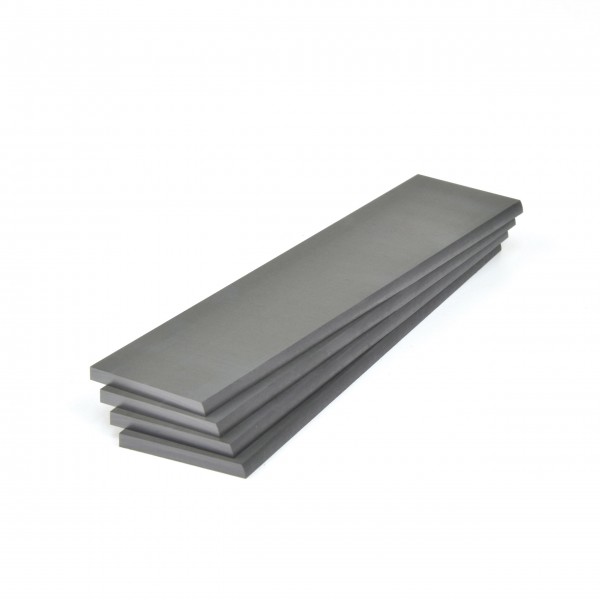 01
01Original BECKER vanes for KDT/KVT 2.80/3.60/3.80
Original BECKER set of 4 carbon vanes for compatible KDT/KVT dry pumps.
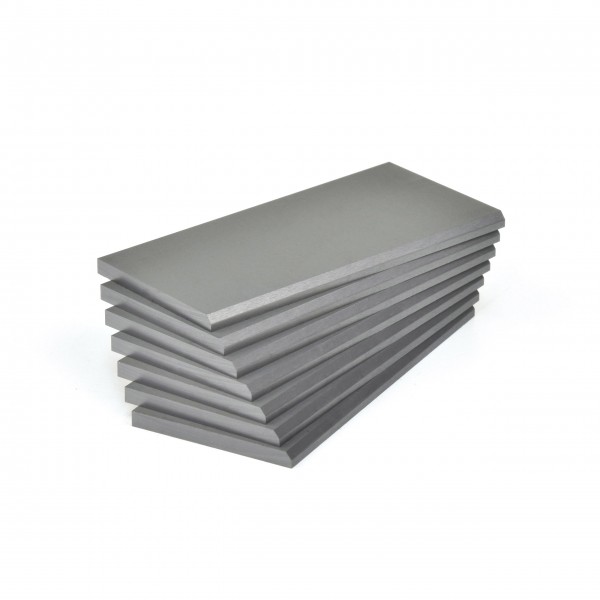 02
02Original BECKER vanes for T3.40 / VT 4.40
Original BECKER carbon-vane set for T3.40 / VT 4.40.
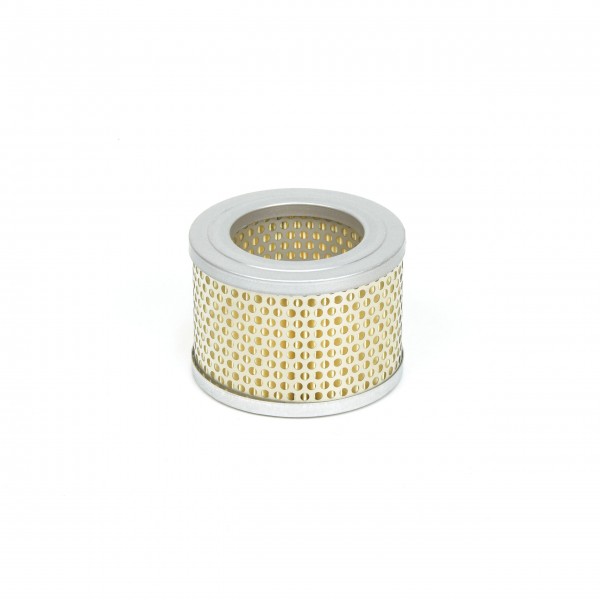 03
03Original BECKER filter cartridge for inlet filtration on multiple pumps and configurations.
Original BECKER filter cartridge for inlet filtration on multiple pumps and configurations.
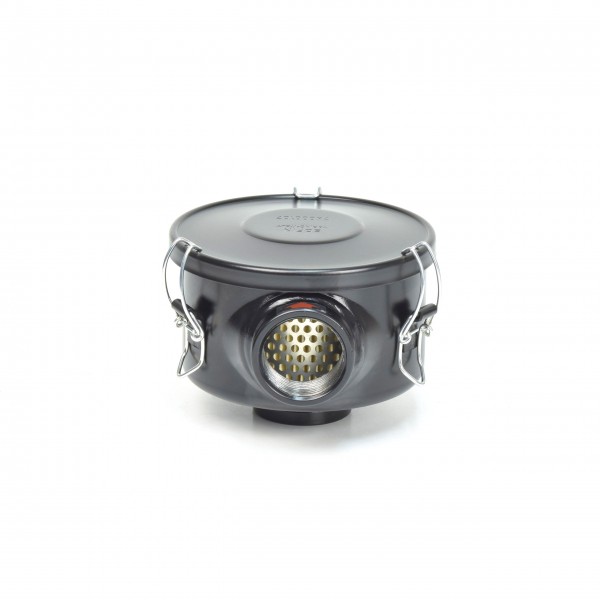 04
04Original BECKER F35 R1 1/4 filter
Original BECKER F35 filter for inlet protection in vacuum applications.
 05
05Original BECKER pressure/vacuum regulating valve
Original regulating valve for setting the required pressure or vacuum level, depending on the application.
 06
06Original BECKER relief valve
Relief valve intended to protect the pump against overpressure conditions.
 07
07Original BECKER non-return valve
Non-return valve to prevent reverse flow when pressure decreases or is lost.
 08
08Original BECKER vacuum/pressure limiting valve
Original valve for limiting the vacuum or pressure level and protecting the system.
 09
09BECKER flow-change valve
Original valve for flow switching in compatible pressure and vacuum applications.
 10
10Original BECKER gas ballast valve
Original BECKER gas ballast valve for compatible pumps and applications that use this function.
Send a clear rating-plate photo, complete model, serial number and the required part so the corresponding original BECKER spare part can be validated.
Four levels of control depending on actual condition
Noise, apparent temperature, cycle time and visual condition of the surrounding area.
Filter, cooling, connections, vibration and cleaning according to service severity.
Vanes and components must be identified from the model documentation and service history.
After liquid ingress, excessive dust, overheating, blockage, abnormal noise or a sudden loss of performance.
Diagnosis of vacuum loss, flow loss, noise and temperature in BECKER pumps
Randomly replacing parts makes diagnosis more expensive. The correct sequence separates process, installation and pump. Start with external, measurable checks; open the pump only when the preceding checks justify it and always follow the model-specific safety procedure.
Isolate energy, prevent unexpected starts, allow the equipment to cool and follow the plant lockout/tagout procedure and the model manual. Do not open a hot or energized pump.
Did the material, recipe, suction cups, porosity, chamber or simultaneity change?
Look for leaks, open valves, collapsed hoses, restrictions and piping changes.
Check fouling, installation, gasket and the correct filter element.
Measure close to the pump and at the consumer to separate pump performance from line losses.
Only then investigate vanes, valves, exhaust, motor and internal pump condition.
| Symptom | Check first | then | When to stop and escalate |
|---|---|---|---|
| Vacuum target not reached | Leaks, valves, gaskets, open process, pressure gauge | Filter, regulation, exhaust, vanes/internal condition | Visible damage, mechanical noise, liquid ingress or a value outside the model range. |
| Takes longer to evacuate | Changed volume/process, leakage, filter, line diameter | Compare vacuum at the pump versus the point of use; review effective flow. | Degradation persists with the network isolated and the filter in good condition. |
| Insufficient flow with apparently correct vacuum | Restrictions, piping, filters, valves, simultaneity | Performance curve/duty point and pump condition | The application requires more flow than the family can deliver. |
| New or abnormal noise | Fasteners, transmitted vibration, exhaust/silencer | Vanes, bearings/motor and components according to the manual | Knocking, rubbing, strong vibration or sudden change: stop and inspect. |
| Elevated temperature | Ventilation, recirculation, filter, exhaust and duty point | motor load, internal contamination and pump condition | Odour, discoloration, trips or increasing abnormal temperature. |
| Unstable vacuum | Valves, intermittent leakage, regulation, cyclic process | Power supply/VARIAIR, sensor and internal condition | Unexplained oscillation that compromises safety or process quality. |
Measure at two points before attributing the loss to the pump
Indicates the vacuum achieved by the pump under the immediate installation conditions.
Indicates what the machine actually receives after piping, filters and valves.
If the difference is large, the loss is in the installation; if both values are poor, continue diagnosis toward the pump or process.
Spare parts and maintenance for BECKER vacuum pumps
Across Africa, Asia and the Middle East, the same component may be described as a spare part, replacement part, vane, blade or service component. Commercial terminology helps with search, but correct technical identification requires the model, variant, serial number and, whenever possible, photographs of the rating plate and installed part.
Do not select vanes or filters by dimensional similarity alone
Version changes, special executions and motor differences can mean that two visually similar pumps use different references. The rating plate is the starting point.
Vanes
Use the correct vane set for the model and configuration. In dry pumps, the vanes are a critical functional component.
Inlet filters
Filter element, gasket and housing must remain clean without introducing excessive restriction.
Valves
Regulating, relief/safety and associated components according to the specific configuration.
Silencers
Exhaust and noise-reduction elements where included in the configuration.
Gaskets and sealing
Sealing kits or components specified for intervention and repair.
Maintenance kits
BECKER publishes maintenance, repair, sealing and fastener kits within its spare-parts program.
Mechanical components
Internal parts or assemblies that require precise identification before quotation.
Motor and electrical configuration
When the requirement involves the motor, frequency converter or electrical configuration, the rating plate and destination-country power supply are essential.
Model, serial number, rating plate, part and quantity allow the correct spare part to be confirmed before shipment.
Identify the correct spare part
Send the model, serial number and a clear rating-plate photograph to validate the BECKER reference.
BECKER vacuum pumps and spare parts for Africa, Asia & the Middle East
Exportvacio supplies BECKER vacuum pumps and spare parts to industrial customers across Africa, Asia and the Middle East, with support for technical product selection, reference identification, 50/60 Hz configuration checks, documentation and international logistics coordination.
Pump selection, original spare parts and quotation support across three major regions
Model, voltage, frequency, application, accessories, destination and logistics requirements are checked before supply is finalized.
One technical contact for selection, supply and spare-part identification
BECKER defines the product technology and specifications; Exportvacio helps translate the plant requirement into a concrete BECKER reference and coordinates quotation, spare parts and shipment to the destination country.
Technical selection
Compare flow, absolute vacuum, frequency, application and actual installation conditions.
Original BECKER spare parts
Identification by model, serial number, rating plate and part reduces supply errors.
International coverage
Commercial support and international logistics coordination for industrial customers across the target regions.
Direct inquiry
Technical and commercial inquiries: comercial@exportvacio.com.
BECKER oil-free vacuum pumps and original spare parts for international industry
Exportvacio supplies BECKER dry-vane pumps, X Series and VARIAIR configurations, together with original spare parts, vanes, filters and maintenance components for industrial projects across Africa, Asia and the Middle East.
Technical search terms: BECKER vacuum pump · dry vane pump · oil-free vacuum · original BECKER vanes · filter · spare parts · 50/60 Hz · VARIAIR.
Identification
New pump, replacement of an existing pump, or original spare-part reference.
Technical validation
Flow, vacuum, 50/60 Hz, voltage, application, accessories and installation conditions.
Quotation
Commercial offer prepared for the required model, destination and technical scope.
International logistics
Shipment coordination according to destination, dimensions, weight and urgency.
Request availability, lead time and logistics for your country
Send the model or application details and destination country for technical and commercial review.
EXPORTVACIO customer reviews — BECKER industrial applications
Comments on integration, stability, maintenance and support in industrial BECKER applications.
Carlos R.
“The pump was very easy to integrate into our line. What we value most is the dry operation and simple day-to-day maintenance. We needed a stable solution for long shifts, and performance has been very good in our application.”
Javier M.
“We replaced an older pump with a KVT 3.80 and the changeover was straightforward. Having the exact reference and electrical configuration clear before ordering helped a lot. The machine now runs with stable, consistent Vacuum for the process.”
Andrés G.
“We use it for holding on a CNC table. The main improvement for us has been stability during long production runs. We also appreciate the straightforward access to filters and maintenance points.”
Diego C.
“We were looking for a compact pump with good performance for suction cups and handling. The VX 4.40 fitted our space and response requirements well. It feels designed for continuous industrial operation.”
Roberto A.
“We moved from a conventional pump because we wanted a longer-service-life solution. The KVX attracted us especially because of the X Series design. After installation, it feels solid and well suited to continuous industrial operation.”
Miguel T.
“The installation supplies several vacuum points and we needed stable flow. The VXLF 2.250 is performing well and the system responds better when several consumers operate at the same time. Correct piping and filter sizing were important.”
Fernando L.
“Vacuum demand changes substantially during our cycle. VARIAIR control is useful because we can match pump speed to the process instead of running at one fixed speed all the time. It gives us a much more flexible operating strategy.”
Alejandro P.
“We needed a simple, compact, oil-free pump for a printing machine. The VT 4.25 met our requirements well. Installation was quick and the vacuum has remained stable during production.”
Ricardo V.
“It is a large pump, but in our case the flow capacity was exactly what we needed. The most important step was reviewing the installation carefully before commissioning. Once everything was adjusted, operation was stable and the pump felt very robust.”
Have you purchased or used a BECKER pump?
Send the model, country, application and a short assessment. If the experience can be verified, it can be added to the catalog as a customer review.
Specifications and differences across 41 BECKER dry-vane models
Compare the differences across 41 BECKER dry-vane models, including flow, absolute vacuum, frequency, power, noise, weight, dimensions, connections, applications and configuration before selecting or replacing a pump.
Absolute vacuum
Compare the model limit with the actual process pressure.
Flow rate 50/60 Hz
Do not mix frequencies; published capacity changes.
Power
Useful for electrical configuration, not as a standalone selection criterion.
Sound level
Data-sheet value under reference conditions; the installation changes perceived noise.
Weight
Important for mounting, handling and logistics.
Integration
Dimensions and connections must be verified before a physical replacement.
Go directly to the technical analysis of the reference.
For a 1:1 replacement, confirm the serial number, configuration, dimensions, connections, electrical supply and corresponding drawing before manufacturing brackets or piping.
Family BECKER VT7 expanded technical dossiers+
MODEL TECHNICAL ANALYSIS
VT 4.2
VT 4.2 belongs to BECKER’s compact, direct dry-vane range, designed for installations that value simple architecture, clean operation and easy integration.
Key technical data
For VT 4.2, compare flow rate, absolute vacuum, power, noise, weight, dimensions and connection data for the required frequency and configuration. For a replacement or new installation, electrical supply, connections and available installation space must also be compatible.
Applications and fit
By architecture and family, the natural application scope includes handling equipment, printing, packaging, holding and automation with relatively stable vacuum demand. Final selection must start from the actual simultaneous flow demand, the vacuum required at the point of use, the duty cycle and the amount of dust or particles that may reach the inlet. A clean, stable application has different priorities from a line with rapid cycles, long piping runs or high ambient contamination.
Spare parts and service
To request spare parts for VT 4.2, identify the complete model, rating plate and, where available, serial number or variant. Vanes, filters, gaskets, valves and service components may differ between generations or configurations. For this reason, ordering by appearance or an incomplete reference is not recommended.
Selection criterion
Correct selection of VT 4.2 is not based simply on “more flow” or “more vacuum”. Check the actual operating point, simultaneity, expected leakage, volume to be evacuated, distance to the user point, future capacity margin and control strategy. An oversized pump may be unnecessary; a pump selected with too little margin may lose stability as conditions vary.
MODEL TECHNICAL ANALYSIS
VT 4.4
VT 4.4 belongs to BECKER’s compact, direct dry-vane range, designed for installations that value simple architecture, clean operation and easy integration.
Key technical data
For VT 4.4, compare flow rate, absolute vacuum, power, noise, weight, dimensions and connection data for the required frequency and configuration. For a replacement or new installation, electrical supply, connections and available installation space must also be compatible.
Applications and fit
By architecture and family, the natural application scope includes handling equipment, printing, packaging, holding and automation with relatively stable vacuum demand. Final selection must start from the actual simultaneous flow demand, the vacuum required at the point of use, the duty cycle and the amount of dust or particles that may reach the inlet. A clean, stable application has different priorities from a line with rapid cycles, long piping runs or high ambient contamination.
Spare parts and service
To request spare parts for VT 4.4, identify the complete model, rating plate and, where available, serial number or variant. Vanes, filters, gaskets, valves and service components may differ between generations or configurations. For this reason, ordering by appearance or an incomplete reference is not recommended.
Selection criterion
Correct selection of VT 4.4 is not based simply on “more flow” or “more vacuum”. Check the actual operating point, simultaneity, expected leakage, volume to be evacuated, distance to the user point, future capacity margin and control strategy. An oversized pump may be unnecessary; a pump selected with too little margin may lose stability as conditions vary.
MODEL TECHNICAL ANALYSIS
VT 4.8
VT 4.8 belongs to BECKER’s compact, direct dry-vane range, designed for installations that value simple architecture, clean operation and easy integration.
Key technical data
For VT 4.8, compare flow rate, absolute vacuum, power, noise, weight, dimensions and connection data for the required frequency and configuration. For a replacement or new installation, electrical supply, connections and available installation space must also be compatible.
Applications and fit
By architecture and family, the natural application scope includes handling equipment, printing, packaging, holding and automation with relatively stable vacuum demand. Final selection must start from the actual simultaneous flow demand, the vacuum required at the point of use, the duty cycle and the amount of dust or particles that may reach the inlet. A clean, stable application has different priorities from a line with rapid cycles, long piping runs or high ambient contamination.
Spare parts and service
To request spare parts for VT 4.8, identify the complete model, rating plate and, where available, serial number or variant. Vanes, filters, gaskets, valves and service components may differ between generations or configurations. For this reason, ordering by appearance or an incomplete reference is not recommended.
Selection criterion
Correct selection of VT 4.8 is not based simply on “more flow” or “more vacuum”. Check the actual operating point, simultaneity, expected leakage, volume to be evacuated, distance to the user point, future capacity margin and control strategy. An oversized pump may be unnecessary; a pump selected with too little margin may lose stability as conditions vary.
MODEL TECHNICAL ANALYSIS
VT 4.10
VT 4.10 belongs to BECKER’s compact, direct dry-vane range, designed for installations that value simple architecture, clean operation and easy integration.
Key technical data
For VT 4.10, compare flow rate, absolute vacuum, power, noise, weight, dimensions and connection data for the required frequency and configuration. For a replacement or new installation, electrical supply, connections and available installation space must also be compatible.
Applications and fit
By architecture and family, the natural application scope includes handling equipment, printing, packaging, holding and automation with relatively stable vacuum demand. Final selection must start from the actual simultaneous flow demand, the vacuum required at the point of use, the duty cycle and the amount of dust or particles that may reach the inlet. A clean, stable application has different priorities from a line with rapid cycles, long piping runs or high ambient contamination.
Spare parts and service
To request spare parts for VT 4.10, identify the complete model, rating plate and, where available, serial number or variant. Vanes, filters, gaskets, valves and service components may differ between generations or configurations. For this reason, ordering by appearance or an incomplete reference is not recommended.
Selection criterion
Correct selection of VT 4.10 is not based simply on “more flow” or “more vacuum”. Check the actual operating point, simultaneity, expected leakage, volume to be evacuated, distance to the user point, future capacity margin and control strategy. An oversized pump may be unnecessary; a pump selected with too little margin may lose stability as conditions vary.
MODEL TECHNICAL ANALYSIS
VT 4.16
VT 4.16 belongs to BECKER’s compact, direct dry-vane range, designed for installations that value simple architecture, clean operation and easy integration.
Key technical data
For VT 4.16, compare flow rate, absolute vacuum, power, noise, weight, dimensions and connection data for the required frequency and configuration. For a replacement or new installation, electrical supply, connections and available installation space must also be compatible.
Applications and fit
By architecture and family, the natural application scope includes handling equipment, printing, packaging, holding and automation with relatively stable vacuum demand. Final selection must start from the actual simultaneous flow demand, the vacuum required at the point of use, the duty cycle and the amount of dust or particles that may reach the inlet. A clean, stable application has different priorities from a line with rapid cycles, long piping runs or high ambient contamination.
Spare parts and service
To request spare parts for VT 4.16, identify the complete model, rating plate and, where available, serial number or variant. Vanes, filters, gaskets, valves and service components may differ between generations or configurations. For this reason, ordering by appearance or an incomplete reference is not recommended.
Selection criterion
Correct selection of VT 4.16 is not based simply on “more flow” or “more vacuum”. Check the actual operating point, simultaneity, expected leakage, volume to be evacuated, distance to the user point, future capacity margin and control strategy. An oversized pump may be unnecessary; a pump selected with too little margin may lose stability as conditions vary.
MODEL TECHNICAL ANALYSIS
VT 4.25
VT 4.25 belongs to BECKER’s compact, direct dry-vane range, designed for installations that value simple architecture, clean operation and easy integration.
Key technical data
For VT 4.25, compare flow rate, absolute vacuum, power, noise, weight, dimensions and connection data for the required frequency and configuration. For a replacement or new installation, electrical supply, connections and available installation space must also be compatible.
Applications and fit
By architecture and family, the natural application scope includes handling equipment, printing, packaging, holding and automation with relatively stable vacuum demand. Final selection must start from the actual simultaneous flow demand, the vacuum required at the point of use, the duty cycle and the amount of dust or particles that may reach the inlet. A clean, stable application has different priorities from a line with rapid cycles, long piping runs or high ambient contamination.
Spare parts and service
To request spare parts for VT 4.25, identify the complete model, rating plate and, where available, serial number or variant. Vanes, filters, gaskets, valves and service components may differ between generations or configurations. For this reason, ordering by appearance or an incomplete reference is not recommended.
Selection criterion
Correct selection of VT 4.25 is not based simply on “more flow” or “more vacuum”. Check the actual operating point, simultaneity, expected leakage, volume to be evacuated, distance to the user point, future capacity margin and control strategy. An oversized pump may be unnecessary; a pump selected with too little margin may lose stability as conditions vary.
MODEL TECHNICAL ANALYSIS
VT 4.40
VT 4.40 belongs to BECKER’s compact, direct dry-vane range, designed for installations that value simple architecture, clean operation and easy integration.
Key technical data
For VT 4.40, compare flow rate, absolute vacuum, power, noise, weight, dimensions and connection data for the required frequency and configuration. For a replacement or new installation, electrical supply, connections and available installation space must also be compatible.
Applications and fit
By architecture and family, the natural application scope includes handling equipment, printing, packaging, holding and automation with relatively stable vacuum demand. Final selection must start from the actual simultaneous flow demand, the vacuum required at the point of use, the duty cycle and the amount of dust or particles that may reach the inlet. A clean, stable application has different priorities from a line with rapid cycles, long piping runs or high ambient contamination.
Spare parts and service
To request spare parts for VT 4.40, identify the complete model, rating plate and, where available, serial number or variant. Vanes, filters, gaskets, valves and service components may differ between generations or configurations. For this reason, ordering by appearance or an incomplete reference is not recommended.
Selection criterion
Correct selection of VT 4.40 is not based simply on “more flow” or “more vacuum”. Check the actual operating point, simultaneity, expected leakage, volume to be evacuated, distance to the user point, future capacity margin and control strategy. An oversized pump may be unnecessary; a pump selected with too little margin may lose stability as conditions vary.
Family BECKER VX4 expanded technical dossiers+
SERIES X· HIGH PERFORMANCE · EXTENDED SERVICE LIFE
VX 4.10
VX 4.10 belongs to the compact X Series rangeX: an evolution designed for industrial integration, operating efficiency and continuous duty within dry-vane technology.
Key technical data
For VX 4.10, compare flow rate, absolute vacuum, power, noise, weight, dimensions and connection data for the required frequency and configuration. For a replacement or new installation, electrical supply, connections and available installation space must also be compatible.
Applications and fit
By architecture and family, the natural application scope includes automation, printing, packaging, handling and repetitive-cycle processes. Final selection must start from the actual simultaneous flow demand, the vacuum required at the point of use, the duty cycle and the amount of dust or particles that may reach the inlet. A clean, stable application has different priorities from a line with rapid cycles, long piping runs or high ambient contamination.
Spare parts and service
To request spare parts for VX 4.10, identify the complete model, rating plate and, where available, serial number or variant. Vanes, filters, gaskets, valves and service components may differ between generations or configurations. For this reason, ordering by appearance or an incomplete reference is not recommended.
Selection criterion
Correct selection of VX 4.10 is not based simply on “more flow” or “more vacuum”. Check the actual operating point, simultaneity, expected leakage, volume to be evacuated, distance to the user point, future capacity margin and control strategy. An oversized pump may be unnecessary; a pump selected with too little margin may lose stability as conditions vary.
SERIES X· HIGH PERFORMANCE · EXTENDED SERVICE LIFE
VX 4.16
VX 4.16 belongs to the compact X Series rangeX: an evolution designed for industrial integration, operating efficiency and continuous duty within dry-vane technology.
Key technical data
For VX 4.16, compare flow rate, absolute vacuum, power, noise, weight, dimensions and connection data for the required frequency and configuration. For a replacement or new installation, electrical supply, connections and available installation space must also be compatible.
Applications and fit
By architecture and family, the natural application scope includes automation, printing, packaging, handling and repetitive-cycle processes. Final selection must start from the actual simultaneous flow demand, the vacuum required at the point of use, the duty cycle and the amount of dust or particles that may reach the inlet. A clean, stable application has different priorities from a line with rapid cycles, long piping runs or high ambient contamination.
Spare parts and service
To request spare parts for VX 4.16, identify the complete model, rating plate and, where available, serial number or variant. Vanes, filters, gaskets, valves and service components may differ between generations or configurations. For this reason, ordering by appearance or an incomplete reference is not recommended.
Selection criterion
Correct selection of VX 4.16 is not based simply on “more flow” or “more vacuum”. Check the actual operating point, simultaneity, expected leakage, volume to be evacuated, distance to the user point, future capacity margin and control strategy. An oversized pump may be unnecessary; a pump selected with too little margin may lose stability as conditions vary.
SERIES X· HIGH PERFORMANCE · EXTENDED SERVICE LIFE
VX 4.25
VX 4.25 belongs to the compact X Series rangeX: an evolution designed for industrial integration, operating efficiency and continuous duty within dry-vane technology.
Key technical data
For VX 4.25, compare flow rate, absolute vacuum, power, noise, weight, dimensions and connection data for the required frequency and configuration. For a replacement or new installation, electrical supply, connections and available installation space must also be compatible.
Applications and fit
By architecture and family, the natural application scope includes automation, printing, packaging, handling and repetitive-cycle processes. Final selection must start from the actual simultaneous flow demand, the vacuum required at the point of use, the duty cycle and the amount of dust or particles that may reach the inlet. A clean, stable application has different priorities from a line with rapid cycles, long piping runs or high ambient contamination.
Spare parts and service
To request spare parts for VX 4.25, identify the complete model, rating plate and, where available, serial number or variant. Vanes, filters, gaskets, valves and service components may differ between generations or configurations. For this reason, ordering by appearance or an incomplete reference is not recommended.
Selection criterion
Correct selection of VX 4.25 is not based simply on “more flow” or “more vacuum”. Check the actual operating point, simultaneity, expected leakage, volume to be evacuated, distance to the user point, future capacity margin and control strategy. An oversized pump may be unnecessary; a pump selected with too little margin may lose stability as conditions vary.
SERIES X· HIGH PERFORMANCE · EXTENDED SERVICE LIFE
VX 4.40
VX 4.40 belongs to the compact X Series rangeX: an evolution designed for industrial integration, operating efficiency and continuous duty within dry-vane technology.
Key technical data
For VX 4.40, compare flow rate, absolute vacuum, power, noise, weight, dimensions and connection data for the required frequency and configuration. For a replacement or new installation, electrical supply, connections and available installation space must also be compatible.
Applications and fit
By architecture and family, the natural application scope includes automation, printing, packaging, handling and repetitive-cycle processes. Final selection must start from the actual simultaneous flow demand, the vacuum required at the point of use, the duty cycle and the amount of dust or particles that may reach the inlet. A clean, stable application has different priorities from a line with rapid cycles, long piping runs or high ambient contamination.
Spare parts and service
To request spare parts for VX 4.40, identify the complete model, rating plate and, where available, serial number or variant. Vanes, filters, gaskets, valves and service components may differ between generations or configurations. For this reason, ordering by appearance or an incomplete reference is not recommended.
Selection criterion
Correct selection of VX 4.40 is not based simply on “more flow” or “more vacuum”. Check the actual operating point, simultaneity, expected leakage, volume to be evacuated, distance to the user point, future capacity margin and control strategy. An oversized pump may be unnecessary; a pump selected with too little margin may lose stability as conditions vary.
Family BECKER KVT4 expanded technical dossiers+
MODEL TECHNICAL ANALYSIS
KVT 3.60
KVT 3.60 is part of BECKER’s higher-capacity dry-vane range, designed to increase available flow while retaining the simplicity of oil-free rotary-vane technology.
Key technical data
For KVT 3.60, compare flow rate, absolute vacuum, power, noise, weight, dimensions and connection data for the required frequency and configuration. For a replacement or new installation, electrical supply, connections and available installation space must also be compatible.
Applications and fit
By architecture and family, the natural application scope includes woodworking, packaging, printing, handling, pneumatic conveying and compact centralized systems. Final selection must start from the actual simultaneous flow demand, the vacuum required at the point of use, the duty cycle and the amount of dust or particles that may reach the inlet. A clean, stable application has different priorities from a line with rapid cycles, long piping runs or high ambient contamination.
Spare parts and service
To request spare parts for KVT 3.60, identify the complete model, rating plate and, where available, serial number or variant. Vanes, filters, gaskets, valves and service components may differ between generations or configurations. For this reason, ordering by appearance or an incomplete reference is not recommended.
Selection criterion
Correct selection of KVT 3.60 is not based simply on “more flow” or “more vacuum”. Check the actual operating point, simultaneity, expected leakage, volume to be evacuated, distance to the user point, future capacity margin and control strategy. An oversized pump may be unnecessary; a pump selected with too little margin may lose stability as conditions vary.
MODEL TECHNICAL ANALYSIS
KVT 3.80
KVT 3.80 is part of BECKER’s higher-capacity dry-vane range, designed to increase available flow while retaining the simplicity of oil-free rotary-vane technology.
Key technical data
For KVT 3.80, compare flow rate, absolute vacuum, power, noise, weight, dimensions and connection data for the required frequency and configuration. For a replacement or new installation, electrical supply, connections and available installation space must also be compatible.
Applications and fit
By architecture and family, the natural application scope includes woodworking, packaging, printing, handling, pneumatic conveying and compact centralized systems. Final selection must start from the actual simultaneous flow demand, the vacuum required at the point of use, the duty cycle and the amount of dust or particles that may reach the inlet. A clean, stable application has different priorities from a line with rapid cycles, long piping runs or high ambient contamination.
Spare parts and service
To request spare parts for KVT 3.80, identify the complete model, rating plate and, where available, serial number or variant. Vanes, filters, gaskets, valves and service components may differ between generations or configurations. For this reason, ordering by appearance or an incomplete reference is not recommended.
Selection criterion
Correct selection of KVT 3.80 is not based simply on “more flow” or “more vacuum”. Check the actual operating point, simultaneity, expected leakage, volume to be evacuated, distance to the user point, future capacity margin and control strategy. An oversized pump may be unnecessary; a pump selected with too little margin may lose stability as conditions vary.
MODEL TECHNICAL ANALYSIS
KVT 3.100
KVT 3.100 is part of BECKER’s higher-capacity dry-vane range, designed to increase available flow while retaining the simplicity of oil-free rotary-vane technology.
Key technical data
For KVT 3.100, compare flow rate, absolute vacuum, power, noise, weight, dimensions and connection data for the required frequency and configuration. For a replacement or new installation, electrical supply, connections and available installation space must also be compatible.
Applications and fit
By architecture and family, the natural application scope includes woodworking, packaging, printing, handling, pneumatic conveying and compact centralized systems. Final selection must start from the actual simultaneous flow demand, the vacuum required at the point of use, the duty cycle and the amount of dust or particles that may reach the inlet. A clean, stable application has different priorities from a line with rapid cycles, long piping runs or high ambient contamination.
Spare parts and service
To request spare parts for KVT 3.100, identify the complete model, rating plate and, where available, serial number or variant. Vanes, filters, gaskets, valves and service components may differ between generations or configurations. For this reason, ordering by appearance or an incomplete reference is not recommended.
Selection criterion
Correct selection of KVT 3.100 is not based simply on “more flow” or “more vacuum”. Check the actual operating point, simultaneity, expected leakage, volume to be evacuated, distance to the user point, future capacity margin and control strategy. An oversized pump may be unnecessary; a pump selected with too little margin may lose stability as conditions vary.
MODEL TECHNICAL ANALYSIS
KVT 3.140
KVT 3.140 is part of BECKER’s higher-capacity dry-vane range, designed to increase available flow while retaining the simplicity of oil-free rotary-vane technology.
Key technical data
For KVT 3.140, compare flow rate, absolute vacuum, power, noise, weight, dimensions and connection data for the required frequency and configuration. For a replacement or new installation, electrical supply, connections and available installation space must also be compatible.
Applications and fit
By architecture and family, the natural application scope includes woodworking, packaging, printing, handling, pneumatic conveying and compact centralized systems. Final selection must start from the actual simultaneous flow demand, the vacuum required at the point of use, the duty cycle and the amount of dust or particles that may reach the inlet. A clean, stable application has different priorities from a line with rapid cycles, long piping runs or high ambient contamination.
Spare parts and service
To request spare parts for KVT 3.140, identify the complete model, rating plate and, where available, serial number or variant. Vanes, filters, gaskets, valves and service components may differ between generations or configurations. For this reason, ordering by appearance or an incomplete reference is not recommended.
Selection criterion
Correct selection of KVT 3.140 is not based simply on “more flow” or “more vacuum”. Check the actual operating point, simultaneity, expected leakage, volume to be evacuated, distance to the user point, future capacity margin and control strategy. An oversized pump may be unnecessary; a pump selected with too little margin may lose stability as conditions vary.
Family BECKER KVX4 expanded technical dossiers+
SERIES X· HIGH PERFORMANCE · EXTENDED SERVICE LIFE
KVX 3.60
KVX 3.60 belongs to the medium-capacity X Series range: a modern dry-vane platform for installations focused on capacity, robustness and industrial integration.
Key technical data
For KVX 3.60, compare flow rate, absolute vacuum, power, noise, weight, dimensions and connection data for the required frequency and configuration. For a replacement or new installation, electrical supply, connections and available installation space must also be compatible.
Applications and fit
By architecture and family, the natural application scope includes automated lines, centralized vacuum systems, woodworking, packaging and handling processes. Final selection must start from the actual simultaneous flow demand, the vacuum required at the point of use, the duty cycle and the amount of dust or particles that may reach the inlet. A clean, stable application has different priorities from a line with rapid cycles, long piping runs or high ambient contamination.
Spare parts and service
To request spare parts for KVX 3.60, identify the complete model, rating plate and, where available, serial number or variant. Vanes, filters, gaskets, valves and service components may differ between generations or configurations. For this reason, ordering by appearance or an incomplete reference is not recommended.
Selection criterion
Correct selection of KVX 3.60 is not based simply on “more flow” or “more vacuum”. Check the actual operating point, simultaneity, expected leakage, volume to be evacuated, distance to the user point, future capacity margin and control strategy. An oversized pump may be unnecessary; a pump selected with too little margin may lose stability as conditions vary.
SERIES X· HIGH PERFORMANCE · EXTENDED SERVICE LIFE
KVX 3.80
KVX 3.80 belongs to the medium-capacity X Series range: a modern dry-vane platform for installations focused on capacity, robustness and industrial integration.
Key technical data
For KVX 3.80, compare flow rate, absolute vacuum, power, noise, weight, dimensions and connection data for the required frequency and configuration. For a replacement or new installation, electrical supply, connections and available installation space must also be compatible.
Applications and fit
By architecture and family, the natural application scope includes automated lines, centralized vacuum systems, woodworking, packaging and handling processes. Final selection must start from the actual simultaneous flow demand, the vacuum required at the point of use, the duty cycle and the amount of dust or particles that may reach the inlet. A clean, stable application has different priorities from a line with rapid cycles, long piping runs or high ambient contamination.
Spare parts and service
To request spare parts for KVX 3.80, identify the complete model, rating plate and, where available, serial number or variant. Vanes, filters, gaskets, valves and service components may differ between generations or configurations. For this reason, ordering by appearance or an incomplete reference is not recommended.
Selection criterion
Correct selection of KVX 3.80 is not based simply on “more flow” or “more vacuum”. Check the actual operating point, simultaneity, expected leakage, volume to be evacuated, distance to the user point, future capacity margin and control strategy. An oversized pump may be unnecessary; a pump selected with too little margin may lose stability as conditions vary.
SERIES X· HIGH PERFORMANCE · EXTENDED SERVICE LIFE
KVX 3.100
KVX 3.100 belongs to the medium-capacity X Series range: a modern dry-vane platform for installations focused on capacity, robustness and industrial integration.
Key technical data
For KVX 3.100, compare flow rate, absolute vacuum, power, noise, weight, dimensions and connection data for the required frequency and configuration. For a replacement or new installation, electrical supply, connections and available installation space must also be compatible.
Applications and fit
By architecture and family, the natural application scope includes automated lines, centralized vacuum systems, woodworking, packaging and handling processes. Final selection must start from the actual simultaneous flow demand, the vacuum required at the point of use, the duty cycle and the amount of dust or particles that may reach the inlet. A clean, stable application has different priorities from a line with rapid cycles, long piping runs or high ambient contamination.
Spare parts and service
To request spare parts for KVX 3.100, identify the complete model, rating plate and, where available, serial number or variant. Vanes, filters, gaskets, valves and service components may differ between generations or configurations. For this reason, ordering by appearance or an incomplete reference is not recommended.
Selection criterion
Correct selection of KVX 3.100 is not based simply on “more flow” or “more vacuum”. Check the actual operating point, simultaneity, expected leakage, volume to be evacuated, distance to the user point, future capacity margin and control strategy. An oversized pump may be unnecessary; a pump selected with too little margin may lose stability as conditions vary.
SERIES X· HIGH PERFORMANCE · EXTENDED SERVICE LIFE
KVX 3.140
KVX 3.140 belongs to the medium-capacity X Series range: a modern dry-vane platform for installations focused on capacity, robustness and industrial integration.
Key technical data
For KVX 3.140, compare flow rate, absolute vacuum, power, noise, weight, dimensions and connection data for the required frequency and configuration. For a replacement or new installation, electrical supply, connections and available installation space must also be compatible.
Applications and fit
By architecture and family, the natural application scope includes automated lines, centralized vacuum systems, woodworking, packaging and handling processes. Final selection must start from the actual simultaneous flow demand, the vacuum required at the point of use, the duty cycle and the amount of dust or particles that may reach the inlet. A clean, stable application has different priorities from a line with rapid cycles, long piping runs or high ambient contamination.
Spare parts and service
To request spare parts for KVX 3.140, identify the complete model, rating plate and, where available, serial number or variant. Vanes, filters, gaskets, valves and service components may differ between generations or configurations. For this reason, ordering by appearance or an incomplete reference is not recommended.
Selection criterion
Correct selection of KVX 3.140 is not based simply on “more flow” or “more vacuum”. Check the actual operating point, simultaneity, expected leakage, volume to be evacuated, distance to the user point, future capacity margin and control strategy. An oversized pump may be unnecessary; a pump selected with too little margin may lose stability as conditions vary.
Family BECKER VTLF6 expanded technical dossiers+
MODEL TECHNICAL ANALYSIS
VTLF 2.200
VTLF 2.200 belongs to BECKER’s high-capacity dry-vane range, designed for high flow rates and continuous industrial operation with an oil-free compression chamber.
Key technical data
For VTLF 2.200, compare flow rate, absolute vacuum, power, noise, weight, dimensions and connection data for the required frequency and configuration. For a replacement or new installation, electrical supply, connections and available installation space must also be compatible.
Applications and fit
By architecture and family, the natural application scope includes central systems, woodworking, printing, packaging, handling and processes requiring higher flow rates. Final selection must start from the actual simultaneous flow demand, the vacuum required at the point of use, the duty cycle and the amount of dust or particles that may reach the inlet. A clean, stable application has different priorities from a line with rapid cycles, long piping runs or high ambient contamination.
Spare parts and service
To request spare parts for VTLF 2.200, identify the complete model, rating plate and, where available, serial number or variant. Vanes, filters, gaskets, valves and service components may differ between generations or configurations. For this reason, ordering by appearance or an incomplete reference is not recommended.
Selection criterion
Correct selection of VTLF 2.200 is not based simply on “more flow” or “more vacuum”. Check the actual operating point, simultaneity, expected leakage, volume to be evacuated, distance to the user point, future capacity margin and control strategy. An oversized pump may be unnecessary; a pump selected with too little margin may lose stability as conditions vary.
MODEL TECHNICAL ANALYSIS
VTLF 2.250
VTLF 2.250 belongs to BECKER’s high-capacity dry-vane range, designed for high flow rates and continuous industrial operation with an oil-free compression chamber.
Key technical data
For VTLF 2.250, compare flow rate, absolute vacuum, power, noise, weight, dimensions and connection data for the required frequency and configuration. For a replacement or new installation, electrical supply, connections and available installation space must also be compatible.
Applications and fit
By architecture and family, the natural application scope includes central systems, woodworking, printing, packaging, handling and processes requiring higher flow rates. Final selection must start from the actual simultaneous flow demand, the vacuum required at the point of use, the duty cycle and the amount of dust or particles that may reach the inlet. A clean, stable application has different priorities from a line with rapid cycles, long piping runs or high ambient contamination.
Spare parts and service
To request spare parts for VTLF 2.250, identify the complete model, rating plate and, where available, serial number or variant. Vanes, filters, gaskets, valves and service components may differ between generations or configurations. For this reason, ordering by appearance or an incomplete reference is not recommended.
Selection criterion
Correct selection of VTLF 2.250 is not based simply on “more flow” or “more vacuum”. Check the actual operating point, simultaneity, expected leakage, volume to be evacuated, distance to the user point, future capacity margin and control strategy. An oversized pump may be unnecessary; a pump selected with too little margin may lose stability as conditions vary.
MODEL TECHNICAL ANALYSIS
VTLF 2.250 SK
VTLF 2.250 SK belongs to BECKER’s high-capacity dry-vane range, designed for high flow rates and continuous industrial operation with an oil-free compression chamber.
Key technical data
For VTLF 2.250 SK, compare flow rate, absolute vacuum, power, noise, weight, dimensions and connection data for the required frequency and configuration. For a replacement or new installation, electrical supply, connections and available installation space must also be compatible.
Applications and fit
By architecture and family, the natural application scope includes central systems, woodworking, printing, packaging, handling and processes requiring higher flow rates. Final selection must start from the actual simultaneous flow demand, the vacuum required at the point of use, the duty cycle and the amount of dust or particles that may reach the inlet. A clean, stable application has different priorities from a line with rapid cycles, long piping runs or high ambient contamination.
Spare parts and service
To request spare parts for VTLF 2.250 SK, identify the complete model, rating plate and, where available, serial number or variant. Vanes, filters, gaskets, valves and service components may differ between generations or configurations. For this reason, ordering by appearance or an incomplete reference is not recommended.
Selection criterion
Correct selection of VTLF 2.250 SK is not based simply on “more flow” or “more vacuum”. Check the actual operating point, simultaneity, expected leakage, volume to be evacuated, distance to the user point, future capacity margin and control strategy. An oversized pump may be unnecessary; a pump selected with too little margin may lose stability as conditions vary.
MODEL TECHNICAL ANALYSIS
VTLF 2.360
VTLF 2.360 belongs to BECKER’s high-capacity dry-vane range, designed for high flow rates and continuous industrial operation with an oil-free compression chamber.
Key technical data
For VTLF 2.360, compare flow rate, absolute vacuum, power, noise, weight, dimensions and connection data for the required frequency and configuration. For a replacement or new installation, electrical supply, connections and available installation space must also be compatible.
Applications and fit
By architecture and family, the natural application scope includes central systems, woodworking, printing, packaging, handling and processes requiring higher flow rates. Final selection must start from the actual simultaneous flow demand, the vacuum required at the point of use, the duty cycle and the amount of dust or particles that may reach the inlet. A clean, stable application has different priorities from a line with rapid cycles, long piping runs or high ambient contamination.
Spare parts and service
To request spare parts for VTLF 2.360, identify the complete model, rating plate and, where available, serial number or variant. Vanes, filters, gaskets, valves and service components may differ between generations or configurations. For this reason, ordering by appearance or an incomplete reference is not recommended.
Selection criterion
Correct selection of VTLF 2.360 is not based simply on “more flow” or “more vacuum”. Check the actual operating point, simultaneity, expected leakage, volume to be evacuated, distance to the user point, future capacity margin and control strategy. An oversized pump may be unnecessary; a pump selected with too little margin may lose stability as conditions vary.
MODEL TECHNICAL ANALYSIS
VTLF 2.400
VTLF 2.400 belongs to BECKER’s high-capacity dry-vane range, designed for high flow rates and continuous industrial operation with an oil-free compression chamber.
Key technical data
For VTLF 2.400, compare flow rate, absolute vacuum, power, noise, weight, dimensions and connection data for the required frequency and configuration. For a replacement or new installation, electrical supply, connections and available installation space must also be compatible.
Applications and fit
By architecture and family, the natural application scope includes central systems, woodworking, printing, packaging, handling and processes requiring higher flow rates. Final selection must start from the actual simultaneous flow demand, the vacuum required at the point of use, the duty cycle and the amount of dust or particles that may reach the inlet. A clean, stable application has different priorities from a line with rapid cycles, long piping runs or high ambient contamination.
Spare parts and service
To request spare parts for VTLF 2.400, identify the complete model, rating plate and, where available, serial number or variant. Vanes, filters, gaskets, valves and service components may differ between generations or configurations. For this reason, ordering by appearance or an incomplete reference is not recommended.
Selection criterion
Correct selection of VTLF 2.400 is not based simply on “more flow” or “more vacuum”. Check the actual operating point, simultaneity, expected leakage, volume to be evacuated, distance to the user point, future capacity margin and control strategy. An oversized pump may be unnecessary; a pump selected with too little margin may lose stability as conditions vary.
MODEL TECHNICAL ANALYSIS
VTLF 2.500
VTLF 2.500 belongs to BECKER’s high-capacity dry-vane range, designed for high flow rates and continuous industrial operation with an oil-free compression chamber.
Key technical data
For VTLF 2.500, compare flow rate, absolute vacuum, power, noise, weight, dimensions and connection data for the required frequency and configuration. For a replacement or new installation, electrical supply, connections and available installation space must also be compatible.
Applications and fit
By architecture and family, the natural application scope includes central systems, woodworking, printing, packaging, handling and processes requiring higher flow rates. Final selection must start from the actual simultaneous flow demand, the vacuum required at the point of use, the duty cycle and the amount of dust or particles that may reach the inlet. A clean, stable application has different priorities from a line with rapid cycles, long piping runs or high ambient contamination.
Spare parts and service
To request spare parts for VTLF 2.500, identify the complete model, rating plate and, where available, serial number or variant. Vanes, filters, gaskets, valves and service components may differ between generations or configurations. For this reason, ordering by appearance or an incomplete reference is not recommended.
Selection criterion
Correct selection of VTLF 2.500 is not based simply on “more flow” or “more vacuum”. Check the actual operating point, simultaneity, expected leakage, volume to be evacuated, distance to the user point, future capacity margin and control strategy. An oversized pump may be unnecessary; a pump selected with too little margin may lose stability as conditions vary.
Family BECKER VXLF5 expanded technical dossiers+
SERIES X· HIGH PERFORMANCE · EXTENDED SERVICE LIFE
VXLF 2.200
VXLF 2.200 belongs to the high-capacity X Series dry-vane rangeXHigh-capacity dry-vane solution focused on industrial integration and service.
Key technical data
For VXLF 2.200, compare flow rate, absolute vacuum, power, noise, weight, dimensions and connection data for the required frequency and configuration. For a replacement or new installation, electrical supply, connections and available installation space must also be compatible.
Applications and fit
By architecture and family, the natural application scope includes central installations, high-demand production lines, woodworking, printing, packaging and automation. Final selection must start from the actual simultaneous flow demand, the vacuum required at the point of use, the duty cycle and the amount of dust or particles that may reach the inlet. A clean, stable application has different priorities from a line with rapid cycles, long piping runs or high ambient contamination.
Spare parts and service
To request spare parts for VXLF 2.200, identify the complete model, rating plate and, where available, serial number or variant. Vanes, filters, gaskets, valves and service components may differ between generations or configurations. For this reason, ordering by appearance or an incomplete reference is not recommended.
Selection criterion
Correct selection of VXLF 2.200 is not based simply on “more flow” or “more vacuum”. Check the actual operating point, simultaneity, expected leakage, volume to be evacuated, distance to the user point, future capacity margin and control strategy. An oversized pump may be unnecessary; a pump selected with too little margin may lose stability as conditions vary.
SERIES X· HIGH PERFORMANCE · EXTENDED SERVICE LIFE
VXLF 2.250
VXLF 2.250 belongs to the high-capacity X Series dry-vane rangeXHigh-capacity dry-vane solution focused on industrial integration and service.
Key technical data
For VXLF 2.250, compare flow rate, absolute vacuum, power, noise, weight, dimensions and connection data for the required frequency and configuration. For a replacement or new installation, electrical supply, connections and available installation space must also be compatible.
Applications and fit
By architecture and family, the natural application scope includes central installations, high-demand production lines, woodworking, printing, packaging and automation. Final selection must start from the actual simultaneous flow demand, the vacuum required at the point of use, the duty cycle and the amount of dust or particles that may reach the inlet. A clean, stable application has different priorities from a line with rapid cycles, long piping runs or high ambient contamination.
Spare parts and service
To request spare parts for VXLF 2.250, identify the complete model, rating plate and, where available, serial number or variant. Vanes, filters, gaskets, valves and service components may differ between generations or configurations. For this reason, ordering by appearance or an incomplete reference is not recommended.
Selection criterion
Correct selection of VXLF 2.250 is not based simply on “more flow” or “more vacuum”. Check the actual operating point, simultaneity, expected leakage, volume to be evacuated, distance to the user point, future capacity margin and control strategy. An oversized pump may be unnecessary; a pump selected with too little margin may lose stability as conditions vary.
SERIES X· HIGH PERFORMANCE · EXTENDED SERVICE LIFE
VXLF 2.250 SK
VXLF 2.250 SK belongs to the high-capacity X Series dry-vane rangeXHigh-capacity dry-vane solution focused on industrial integration and service.
Key technical data
For VXLF 2.250 SK, compare flow rate, absolute vacuum, power, noise, weight, dimensions and connection data for the required frequency and configuration. For a replacement or new installation, electrical supply, connections and available installation space must also be compatible.
Applications and fit
By architecture and family, the natural application scope includes central installations, high-demand production lines, woodworking, printing, packaging and automation. Final selection must start from the actual simultaneous flow demand, the vacuum required at the point of use, the duty cycle and the amount of dust or particles that may reach the inlet. A clean, stable application has different priorities from a line with rapid cycles, long piping runs or high ambient contamination.
Spare parts and service
To request spare parts for VXLF 2.250 SK, identify the complete model, rating plate and, where available, serial number or variant. Vanes, filters, gaskets, valves and service components may differ between generations or configurations. For this reason, ordering by appearance or an incomplete reference is not recommended.
Selection criterion
Correct selection of VXLF 2.250 SK is not based simply on “more flow” or “more vacuum”. Check the actual operating point, simultaneity, expected leakage, volume to be evacuated, distance to the user point, future capacity margin and control strategy. An oversized pump may be unnecessary; a pump selected with too little margin may lose stability as conditions vary.
SERIES X· HIGH PERFORMANCE · EXTENDED SERVICE LIFE
VXLF 2.400
VXLF 2.400 belongs to the high-capacity X Series dry-vane rangeXHigh-capacity dry-vane solution focused on industrial integration and service.
Key technical data
For VXLF 2.400, compare flow rate, absolute vacuum, power, noise, weight, dimensions and connection data for the required frequency and configuration. For a replacement or new installation, electrical supply, connections and available installation space must also be compatible.
Applications and fit
By architecture and family, the natural application scope includes central installations, high-demand production lines, woodworking, printing, packaging and automation. Final selection must start from the actual simultaneous flow demand, the vacuum required at the point of use, the duty cycle and the amount of dust or particles that may reach the inlet. A clean, stable application has different priorities from a line with rapid cycles, long piping runs or high ambient contamination.
Spare parts and service
To request spare parts for VXLF 2.400, identify the complete model, rating plate and, where available, serial number or variant. Vanes, filters, gaskets, valves and service components may differ between generations or configurations. For this reason, ordering by appearance or an incomplete reference is not recommended.
Selection criterion
Correct selection of VXLF 2.400 is not based simply on “more flow” or “more vacuum”. Check the actual operating point, simultaneity, expected leakage, volume to be evacuated, distance to the user point, future capacity margin and control strategy. An oversized pump may be unnecessary; a pump selected with too little margin may lose stability as conditions vary.
SERIES X· HIGH PERFORMANCE · EXTENDED SERVICE LIFE
VXLF 2.500
VXLF 2.500 belongs to the high-capacity X Series dry-vane rangeXHigh-capacity dry-vane solution focused on industrial integration and service.
Key technical data
For VXLF 2.500, compare flow rate, absolute vacuum, power, noise, weight, dimensions and connection data for the required frequency and configuration. For a replacement or new installation, electrical supply, connections and available installation space must also be compatible.
Applications and fit
By architecture and family, the natural application scope includes central installations, high-demand production lines, woodworking, printing, packaging and automation. Final selection must start from the actual simultaneous flow demand, the vacuum required at the point of use, the duty cycle and the amount of dust or particles that may reach the inlet. A clean, stable application has different priorities from a line with rapid cycles, long piping runs or high ambient contamination.
Spare parts and service
To request spare parts for VXLF 2.500, identify the complete model, rating plate and, where available, serial number or variant. Vanes, filters, gaskets, valves and service components may differ between generations or configurations. For this reason, ordering by appearance or an incomplete reference is not recommended.
Selection criterion
Correct selection of VXLF 2.500 is not based simply on “more flow” or “more vacuum”. Check the actual operating point, simultaneity, expected leakage, volume to be evacuated, distance to the user point, future capacity margin and control strategy. An oversized pump may be unnecessary; a pump selected with too little margin may lose stability as conditions vary.
Family BECKER VARIAIR11 expanded technical dossiers+
MODEL TECHNICAL ANALYSIS
VARIAIR KVT 3.80/0-400
VARIAIR KVT 3.80/0-400 is part of BECKER's variable-speed VARIAIR range, using a frequency converter to match vacuum production to actual process demand. In VARIAIR versions, speed control adds an adjustable operating layer; the real benefit depends on the demand profile and system configuration.
Key technical data
For VARIAIR KVT 3.80/0-400, compare flow rate, absolute vacuum, power, noise, weight, dimensions and connection data for the required frequency and configuration. For a replacement or new installation, electrical supply, connections and available installation space must also be compatible.
Applications and fit
By architecture and family, the natural application scope includes installations with variable consumption, multiple consumers, intermittent cycles and tighter duty-point control requirements. Final selection must start from the actual simultaneous flow demand, the vacuum required at the point of use, the duty cycle and the amount of dust or particles that may reach the inlet. A clean, stable application has different priorities from a line with rapid cycles, long piping runs or high ambient contamination.
Spare parts and service
To request spare parts for VARIAIR KVT 3.80/0-400, identify the complete model, rating plate and, where available, serial number or variant. Vanes, filters, gaskets, valves and service components may differ between generations or configurations. For this reason, ordering by appearance or an incomplete reference is not recommended.
Selection criterion
Correct selection of VARIAIR KVT 3.80/0-400 is not based simply on “more flow” or “more vacuum”. Check the actual operating point, simultaneity, expected leakage, volume to be evacuated, distance to the user point, future capacity margin and control strategy. An oversized pump may be unnecessary; a pump selected with too little margin may lose stability as conditions vary.
MODEL TECHNICAL ANALYSIS
VARIAIR KVT 3.100/0-400
VARIAIR KVT 3.100/0-400 is part of BECKER's variable-speed VARIAIR range, using a frequency converter to match vacuum production to actual process demand. In VARIAIR versions, speed control adds an adjustable operating layer; the real benefit depends on the demand profile and system configuration.
Key technical data
For VARIAIR KVT 3.100/0-400, compare flow rate, absolute vacuum, power, noise, weight, dimensions and connection data for the required frequency and configuration. For a replacement or new installation, electrical supply, connections and available installation space must also be compatible.
Applications and fit
By architecture and family, the natural application scope includes installations with variable consumption, multiple consumers, intermittent cycles and tighter duty-point control requirements. Final selection must start from the actual simultaneous flow demand, the vacuum required at the point of use, the duty cycle and the amount of dust or particles that may reach the inlet. A clean, stable application has different priorities from a line with rapid cycles, long piping runs or high ambient contamination.
Spare parts and service
To request spare parts for VARIAIR KVT 3.100/0-400, identify the complete model, rating plate and, where available, serial number or variant. Vanes, filters, gaskets, valves and service components may differ between generations or configurations. For this reason, ordering by appearance or an incomplete reference is not recommended.
Selection criterion
Correct selection of VARIAIR KVT 3.100/0-400 is not based simply on “more flow” or “more vacuum”. Check the actual operating point, simultaneity, expected leakage, volume to be evacuated, distance to the user point, future capacity margin and control strategy. An oversized pump may be unnecessary; a pump selected with too little margin may lose stability as conditions vary.
MODEL TECHNICAL ANALYSIS
VARIAIR KVT 3.140/0-400
VARIAIR KVT 3.140/0-400 is part of BECKER's variable-speed VARIAIR range, using a frequency converter to match vacuum production to actual process demand. In VARIAIR versions, speed control adds an adjustable operating layer; the real benefit depends on the demand profile and system configuration.
Key technical data
For VARIAIR KVT 3.140/0-400, compare flow rate, absolute vacuum, power, noise, weight, dimensions and connection data for the required frequency and configuration. For a replacement or new installation, electrical supply, connections and available installation space must also be compatible.
Applications and fit
By architecture and family, the natural application scope includes installations with variable consumption, multiple consumers, intermittent cycles and tighter duty-point control requirements. Final selection must start from the actual simultaneous flow demand, the vacuum required at the point of use, the duty cycle and the amount of dust or particles that may reach the inlet. A clean, stable application has different priorities from a line with rapid cycles, long piping runs or high ambient contamination.
Spare parts and service
To request spare parts for VARIAIR KVT 3.140/0-400, identify the complete model, rating plate and, where available, serial number or variant. Vanes, filters, gaskets, valves and service components may differ between generations or configurations. For this reason, ordering by appearance or an incomplete reference is not recommended.
Selection criterion
Correct selection of VARIAIR KVT 3.140/0-400 is not based simply on “more flow” or “more vacuum”. Check the actual operating point, simultaneity, expected leakage, volume to be evacuated, distance to the user point, future capacity margin and control strategy. An oversized pump may be unnecessary; a pump selected with too little margin may lose stability as conditions vary.
MODEL TECHNICAL ANALYSIS
VARIAIR KVX 3.80/0-400
VARIAIR KVX 3.80/0-400 is part of BECKER's variable-speed VARIAIR range, using a frequency converter to match vacuum production to actual process demand. In VARIAIR versions, speed control adds an adjustable operating layer; the real benefit depends on the demand profile and system configuration.
Key technical data
For VARIAIR KVX 3.80/0-400, compare flow rate, absolute vacuum, power, noise, weight, dimensions and connection data for the required frequency and configuration. For a replacement or new installation, electrical supply, connections and available installation space must also be compatible.
Applications and fit
By architecture and family, the natural application scope includes installations with variable consumption, multiple consumers, intermittent cycles and tighter duty-point control requirements. Final selection must start from the actual simultaneous flow demand, the vacuum required at the point of use, the duty cycle and the amount of dust or particles that may reach the inlet. A clean, stable application has different priorities from a line with rapid cycles, long piping runs or high ambient contamination.
Spare parts and service
To request spare parts for VARIAIR KVX 3.80/0-400, identify the complete model, rating plate and, where available, serial number or variant. Vanes, filters, gaskets, valves and service components may differ between generations or configurations. For this reason, ordering by appearance or an incomplete reference is not recommended.
Selection criterion
Correct selection of VARIAIR KVX 3.80/0-400 is not based simply on “more flow” or “more vacuum”. Check the actual operating point, simultaneity, expected leakage, volume to be evacuated, distance to the user point, future capacity margin and control strategy. An oversized pump may be unnecessary; a pump selected with too little margin may lose stability as conditions vary.
MODEL TECHNICAL ANALYSIS
VARIAIR KVX 3.100/0-400
VARIAIR KVX 3.100/0-400 is part of BECKER's variable-speed VARIAIR range, using a frequency converter to match vacuum production to actual process demand. In VARIAIR versions, speed control adds an adjustable operating layer; the real benefit depends on the demand profile and system configuration.
Key technical data
For VARIAIR KVX 3.100/0-400, compare flow rate, absolute vacuum, power, noise, weight, dimensions and connection data for the required frequency and configuration. For a replacement or new installation, electrical supply, connections and available installation space must also be compatible.
Applications and fit
By architecture and family, the natural application scope includes installations with variable consumption, multiple consumers, intermittent cycles and tighter duty-point control requirements. Final selection must start from the actual simultaneous flow demand, the vacuum required at the point of use, the duty cycle and the amount of dust or particles that may reach the inlet. A clean, stable application has different priorities from a line with rapid cycles, long piping runs or high ambient contamination.
Spare parts and service
To request spare parts for VARIAIR KVX 3.100/0-400, identify the complete model, rating plate and, where available, serial number or variant. Vanes, filters, gaskets, valves and service components may differ between generations or configurations. For this reason, ordering by appearance or an incomplete reference is not recommended.
Selection criterion
Correct selection of VARIAIR KVX 3.100/0-400 is not based simply on “more flow” or “more vacuum”. Check the actual operating point, simultaneity, expected leakage, volume to be evacuated, distance to the user point, future capacity margin and control strategy. An oversized pump may be unnecessary; a pump selected with too little margin may lose stability as conditions vary.
MODEL TECHNICAL ANALYSIS
VARIAIR KVX 3.140/0-400
VARIAIR KVX 3.140/0-400 is part of BECKER's variable-speed VARIAIR range, using a frequency converter to match vacuum production to actual process demand. In VARIAIR versions, speed control adds an adjustable operating layer; the real benefit depends on the demand profile and system configuration.
Key technical data
For VARIAIR KVX 3.140/0-400, compare flow rate, absolute vacuum, power, noise, weight, dimensions and connection data for the required frequency and configuration. For a replacement or new installation, electrical supply, connections and available installation space must also be compatible.
Applications and fit
By architecture and family, the natural application scope includes installations with variable consumption, multiple consumers, intermittent cycles and tighter duty-point control requirements. Final selection must start from the actual simultaneous flow demand, the vacuum required at the point of use, the duty cycle and the amount of dust or particles that may reach the inlet. A clean, stable application has different priorities from a line with rapid cycles, long piping runs or high ambient contamination.
Spare parts and service
To request spare parts for VARIAIR KVX 3.140/0-400, identify the complete model, rating plate and, where available, serial number or variant. Vanes, filters, gaskets, valves and service components may differ between generations or configurations. For this reason, ordering by appearance or an incomplete reference is not recommended.
Selection criterion
Correct selection of VARIAIR KVX 3.140/0-400 is not based simply on “more flow” or “more vacuum”. Check the actual operating point, simultaneity, expected leakage, volume to be evacuated, distance to the user point, future capacity margin and control strategy. An oversized pump may be unnecessary; a pump selected with too little margin may lose stability as conditions vary.
MODEL TECHNICAL ANALYSIS
VARIAIR VTLF 2.250/0-400
VARIAIR VTLF 2.250/0-400 is part of BECKER's variable-speed VARIAIR range, using a frequency converter to match vacuum production to actual process demand. In VARIAIR versions, speed control adds an adjustable operating layer; the real benefit depends on the demand profile and system configuration.
Key technical data
For VARIAIR VTLF 2.250/0-400, compare flow rate, absolute vacuum, power, noise, weight, dimensions and connection data for the required frequency and configuration. For a replacement or new installation, electrical supply, connections and available installation space must also be compatible.
Applications and fit
By architecture and family, the natural application scope includes installations with variable consumption, multiple consumers, intermittent cycles and tighter duty-point control requirements. Final selection must start from the actual simultaneous flow demand, the vacuum required at the point of use, the duty cycle and the amount of dust or particles that may reach the inlet. A clean, stable application has different priorities from a line with rapid cycles, long piping runs or high ambient contamination.
Spare parts and service
To request spare parts for VARIAIR VTLF 2.250/0-400, identify the complete model, rating plate and, where available, serial number or variant. Vanes, filters, gaskets, valves and service components may differ between generations or configurations. For this reason, ordering by appearance or an incomplete reference is not recommended.
Selection criterion
Correct selection of VARIAIR VTLF 2.250/0-400 is not based simply on “more flow” or “more vacuum”. Check the actual operating point, simultaneity, expected leakage, volume to be evacuated, distance to the user point, future capacity margin and control strategy. An oversized pump may be unnecessary; a pump selected with too little margin may lose stability as conditions vary.
MODEL TECHNICAL ANALYSIS
VARIAIR VTLF 2.360/0-400
VARIAIR VTLF 2.360/0-400 is part of BECKER's variable-speed VARIAIR range, using a frequency converter to match vacuum production to actual process demand. In VARIAIR versions, speed control adds an adjustable operating layer; the real benefit depends on the demand profile and system configuration.
Key technical data
For VARIAIR VTLF 2.360/0-400, compare flow rate, absolute vacuum, power, noise, weight, dimensions and connection data for the required frequency and configuration. For a replacement or new installation, electrical supply, connections and available installation space must also be compatible.
Applications and fit
By architecture and family, the natural application scope includes installations with variable consumption, multiple consumers, intermittent cycles and tighter duty-point control requirements. Final selection must start from the actual simultaneous flow demand, the vacuum required at the point of use, the duty cycle and the amount of dust or particles that may reach the inlet. A clean, stable application has different priorities from a line with rapid cycles, long piping runs or high ambient contamination.
Spare parts and service
To request spare parts for VARIAIR VTLF 2.360/0-400, identify the complete model, rating plate and, where available, serial number or variant. Vanes, filters, gaskets, valves and service components may differ between generations or configurations. For this reason, ordering by appearance or an incomplete reference is not recommended.
Selection criterion
Correct selection of VARIAIR VTLF 2.360/0-400 is not based simply on “more flow” or “more vacuum”. Check the actual operating point, simultaneity, expected leakage, volume to be evacuated, distance to the user point, future capacity margin and control strategy. An oversized pump may be unnecessary; a pump selected with too little margin may lose stability as conditions vary.
MODEL TECHNICAL ANALYSIS
VARIAIR VTLF 2.500/0-400
VARIAIR VTLF 2.500/0-400 is part of BECKER's variable-speed VARIAIR range, using a frequency converter to match vacuum production to actual process demand. In VARIAIR versions, speed control adds an adjustable operating layer; the real benefit depends on the demand profile and system configuration.
Key technical data
For VARIAIR VTLF 2.500/0-400, compare flow rate, absolute vacuum, power, noise, weight, dimensions and connection data for the required frequency and configuration. For a replacement or new installation, electrical supply, connections and available installation space must also be compatible.
Applications and fit
By architecture and family, the natural application scope includes installations with variable consumption, multiple consumers, intermittent cycles and tighter duty-point control requirements. Final selection must start from the actual simultaneous flow demand, the vacuum required at the point of use, the duty cycle and the amount of dust or particles that may reach the inlet. A clean, stable application has different priorities from a line with rapid cycles, long piping runs or high ambient contamination.
Spare parts and service
To request spare parts for VARIAIR VTLF 2.500/0-400, identify the complete model, rating plate and, where available, serial number or variant. Vanes, filters, gaskets, valves and service components may differ between generations or configurations. For this reason, ordering by appearance or an incomplete reference is not recommended.
Selection criterion
Correct selection of VARIAIR VTLF 2.500/0-400 is not based simply on “more flow” or “more vacuum”. Check the actual operating point, simultaneity, expected leakage, volume to be evacuated, distance to the user point, future capacity margin and control strategy. An oversized pump may be unnecessary; a pump selected with too little margin may lose stability as conditions vary.
MODEL TECHNICAL ANALYSIS
VARIAIR VXLF 2.250/0-400
VARIAIR VXLF 2.250/0-400 is part of BECKER's variable-speed VARIAIR range, using a frequency converter to match vacuum production to actual process demand. In VARIAIR versions, speed control adds an adjustable operating layer; the real benefit depends on the demand profile and system configuration.
Key technical data
For VARIAIR VXLF 2.250/0-400, compare flow rate, absolute vacuum, power, noise, weight, dimensions and connection data for the required frequency and configuration. For a replacement or new installation, electrical supply, connections and available installation space must also be compatible.
Applications and fit
By architecture and family, the natural application scope includes installations with variable consumption, multiple consumers, intermittent cycles and tighter duty-point control requirements. Final selection must start from the actual simultaneous flow demand, the vacuum required at the point of use, the duty cycle and the amount of dust or particles that may reach the inlet. A clean, stable application has different priorities from a line with rapid cycles, long piping runs or high ambient contamination.
Spare parts and service
To request spare parts for VARIAIR VXLF 2.250/0-400, identify the complete model, rating plate and, where available, serial number or variant. Vanes, filters, gaskets, valves and service components may differ between generations or configurations. For this reason, ordering by appearance or an incomplete reference is not recommended.
Selection criterion
Correct selection of VARIAIR VXLF 2.250/0-400 is not based simply on “more flow” or “more vacuum”. Check the actual operating point, simultaneity, expected leakage, volume to be evacuated, distance to the user point, future capacity margin and control strategy. An oversized pump may be unnecessary; a pump selected with too little margin may lose stability as conditions vary.
MODEL TECHNICAL ANALYSIS
VARIAIR VXLF 2.500/0-400
VARIAIR VXLF 2.500/0-400 is part of BECKER's variable-speed VARIAIR range, using a frequency converter to match vacuum production to actual process demand. In VARIAIR versions, speed control adds an adjustable operating layer; the real benefit depends on the demand profile and system configuration.
Key technical data
For VARIAIR VXLF 2.500/0-400, compare flow rate, absolute vacuum, power, noise, weight, dimensions and connection data for the required frequency and configuration. For a replacement or new installation, electrical supply, connections and available installation space must also be compatible.
Applications and fit
By architecture and family, the natural application scope includes installations with variable consumption, multiple consumers, intermittent cycles and tighter duty-point control requirements. Final selection must start from the actual simultaneous flow demand, the vacuum required at the point of use, the duty cycle and the amount of dust or particles that may reach the inlet. A clean, stable application has different priorities from a line with rapid cycles, long piping runs or high ambient contamination.
Spare parts and service
To request spare parts for VARIAIR VXLF 2.500/0-400, identify the complete model, rating plate and, where available, serial number or variant. Vanes, filters, gaskets, valves and service components may differ between generations or configurations. For this reason, ordering by appearance or an incomplete reference is not recommended.
Selection criterion
Correct selection of VARIAIR VXLF 2.500/0-400 is not based simply on “more flow” or “more vacuum”. Check the actual operating point, simultaneity, expected leakage, volume to be evacuated, distance to the user point, future capacity margin and control strategy. An oversized pump may be unnecessary; a pump selected with too little margin may lose stability as conditions vary.
FAQ on BECKER oil-free vacuum pumps: selection, maintenance and spare parts
Selection, maintenance, replacement and spare parts for BECKER dry-vane pumps, with answers focused on the data required to select and maintain each application correctly.
01What does it mean when a BECKER pump is “oil-free” or dry-vane?
It means that the compression chamber operates without process oil. Self-lubricating vanes enable dry operation. It does not mean the pump requires no filters, inspection, cleaning or replacement of wear components.
02What is the difference between BECKER VT and VX?
Both are compact dry-vane families. VX belongs to the X SeriesXand BECKER publishes vanes specifically designed for up to 20,000 hours for this range. Final selection must still compare flow, vacuum, frequency and operating conditions.
03What is the difference between KVT and KVX?
KVT and KVX cover the medium-flow area of the dry range. KVX is the X Series variantX. Do not select solely on that distinction: the actual duty point and specific configuration must be checked.
04When should VTLF or VXLF be considered?
When the process requires high flow within the dry-vane range. VTLF is the conventional family and VXLF belongs to the X SeriesX. Exact vacuum and flow depend on the model and on 50/60 Hz operation.
05When does BECKER VARIAIR make sense?
When vacuum demand changes significantly during the process and speed matching is technically appropriate, first define the real demand profile; then validate the VARIAIR family and its frequency range.
06Should vacuum be specified in mbar absolute or as gauge pressure?
For technical selection, use absolute pressure whenever possible because it avoids ambiguity and matches the way these series are specified. If starting from gauge pressure, account for local atmospheric pressure, especially at high altitude.
07Does a 60 Hz pump provide the same flow as a 50 Hz pump?
Not necessarily. BECKER data sheets publish separate flow, power, vacuum and noise values for 50 and 60 Hz on fixed-speed models. The destination-country electrical network must be defined before the final reference is confirmed.
08Can I select a CNC vacuum pump based only on table size?
No. For CNC tables, sacrificial-board porosity, open zones, leakage, manifold diameter and length, filtration and holding pressure all matter. Two tables of the same size can require very different flow rates.
09What happens if the process draws moisture or condensate?
The suitability of dry-vane technology must be reviewed and the pump protected against liquid carry-over. A market label such as “water treatment” or “packaging” does not by itself guarantee that a dry pump is appropriate.
10Why can a BECKER pump lose vacuum or flow?
Common causes should be investigated in order: process change, leakage, valves, hoses or piping, filter condition, measurement, exhaust restrictions and finally the internal condition of the pump and vanes. Measuring near the pump and at the consumer helps separate installation losses from pump performance.
11How often should the vanes be replaced?
There is no universal inspection interval valid for all pumps and applications. Follow the model documentation and adjust inspection frequency to dust, temperature, operating vacuum, service hours and historical behaviour. The SeriesXBECKER publishes a vane design life of up to 20,000 hours for the relevant X Series families, subject to actual application and operating conditions.
12What data is needed to order BECKER vanes, filters or a maintenance kit?
Complete model, serial number or index, a legible rating-plate photograph, a photograph of the part or its location, quantity and delivery country. This reduces the risk of confusing visually similar variants.
13Does Exportvacio supply BECKER pumps and spare parts to Africa, Asia and the Middle East?
Exportvacio.com supports international inquiries and supplies across Africa, Asia and the Middle East, including markets such as the United Arab Emirates, Saudi Arabia, Qatar, Oman, Bahrain, Kuwait, South Africa, Egypt, Morocco, Kenya, Nigeria, India, Singapore, Malaysia, Thailand and Indonesia.
14Can I replace an old pump using only a photograph?
A photograph helps, but it is not sufficient to validate a 1:1 replacement. Provide the rating plate, critical dimensions, connections, power supply, application and duty point whenever possible.
15What should I send to request a quotation for a new BECKER pump?
Application, flow rate or volume/time, operating vacuum, country, voltage/frequency, service hours and any installation restriction. If a pump is already installed, add photographs of the rating plate and installation.
Request BECKER pump selection, spare parts or a quotation from Exportvacio for Africa, Asia & Middle East
Exportvacio supplies BECKER vacuum pumps and spare parts for Africa, Asia & Middle East and supports technical selection and quotations. Indicate the type of inquiry and the available technical data so the correct reference can be validated.
I need a new pump
Send the application, vacuum, flow rate or volume/time, country, voltage/frequency and operating hours.
Request selectionI want to replace a pump
Send the rating plate, installation photos, connections, power supply and the problem or change motivating the replacement.
Validate replacementI need a spare part
Send the model, serial number, rating-plate photo, requested part, quantity and destination.
Request spare partDo not hold up the inquiry if some data are missing. Send the machine model, application, photographs, country and the result you need; that information is enough to begin narrowing down the selection.
BECKER industrial vacuum technology for international projects
Use this catalog to compare BECKER dry-vane vacuum pump families by flow, operating vacuum, frequency, power and application. For projects in Africa, Asia and the Middle East, Exportvacio can review the operating point, electrical supply, environment and required accessories before quotation.